Thursday, April 13, 2017

The Personal Pick - Part Four - The Missing Link


If " Missing Link " sounds a little dramatic, consider the way that your work colleagues show you the pictures of the weddings, sports carnivals, and car shows that they attend.

They pull out a $ 1000 device with a sctratched or broken glass screen on the front and a little symbol of half a battery flashing on and off. They frantically tap away at it and then swipe their fingers left, right, up, and down trying to make a 3 1/2 inch by 5 inch picture appear. Like as not, if it actually is found, it will have enough Instagram filters on it to look like an 1880 cabinet card, but you may not be able to see this before the little battery symbol winks out and the screen goes black. Then you can watch your colleague sitting in their car for half an hour until the phone charges up again.

In the meantime, you can look at an album of prints...

I am suggesting that either you need to come on down to the Murray Street shop of Camera Electronic and get a set of prints made on the Fujifilm printing system...or steer down to the third island stand in the shop and look seriously at the Epson SureColor SC - P600 and P800 inkjet printers. They are two of the very best ways for a serious enthusiast to escape from the dungeon of the mobile screen.

Don't get me wrong - I thoroughly respect putting pictures on a computer screen. As this column is getting typed on an iPad, the main computer is burning off belly-dance discs from a recent show. I daresay few of them will end up as prints. That is the ephemeral nature of the dance shot. But if ever I take a doozey, that one deserves to be at least an A4 print. I rely upon the Epson A3+ printer in my studio to do it, and frequently it does a great deal more. Enough images and some good paper and you have an exhibition.

The P600 most closely corresponds to the Epson printer I use - the A3+ size. If I needed to go up to A2 it would be the P800. Both use the K3 Epson inks for the same result on the paper. The,smaller printer uses smaller ink cartridges, which means a higher price per ml for the ink, but also means that if I do not print as extensively, I am not risking larger quantities that may go stale or flat. This is a real thing and whichever printer one chooses, it is wise to cycle it through with at least one print per week.

Note on the sign that there is a cashback and roll paper adapter on offer as special inducements. I have used an adapter and can report it as a successful when you want long banners or odd sizes of print. Otherwise there are good supplies of Hähnemuele and Ilford papers to suit every taste.

These days there are very easy connections possible between the printers and the computers. I use a simple plugged cord for mine but could have chosen a wireless connection instead. Networking is also available, if you don't mind someone else using up all your ink and paper.

I lock mine away.

Labels: , , , , , , ,

Thursday, January 26, 2017

The Giant Economy Size


We sell lots of things in Camera Electronic that are intended to be small; Olympus cameras, Gitzo traveller's tripods, Metz LED lights. But we also sometimes lash out and get the Giant Economy Size. Case in point: The Premier Eco Print Shield cans.

These are a liquid coating for your inkjet paper and canvas prints that will stop the UV rays from messing with the colours - they also stop airborne pollutants and moisture from ruining the surface of the print. This may not seem important if all your pictures are on your iPhone or 6 x 4 postcards in a shoe box...but the big boys and girls who print out on large format printers and frame their exhibition work know different.

Now the statement that something stops UV damage completely is a difficult one to make - particularly in Western Australia where we manufacture ultraviolet radiation for export. You have only to listen to the weather reports every day to realise that our WA UV index scale starts at " Extreme " and goes up from there. About the only complete UV protection for anything is to put it inside the turret of a Sherman tank and close the hatch...

But the Premier Eco Print Shield does help. It can make the difference for an interior display between a year's safety and 5 years. If you are selling your work, that is important...it gives you time to get away.

Two finishes in stock - Matte and Satin, and you can spread it with bush, roller, or spray gun. If you choose the last mode of delivery you will need a gun with a wide throat to get this solution out...and make sure that you clear and clean your gun between applications. This is thick stuff.

If your needs are more modest, there is also the Hahnemühle spray in aerosol cans - some pros rely on this exclusively.

Note to those people whose entire portfolio is on their iPhones, iPads, or the 8-year old computer that seems to be a little slower at booting up these days...Start to print out some of your best work. The thrill of seeing it in the hand and on the wall is reward enough for your trouble. And people will think of your output in more concrete terms when it is hanging off the concrete.

Plus...for those with the entire portfolio on the Fisher-Price My First Hard Drive...remember the old Bond's underwear ad slogan..." One day, you're gonna get caught..".


Labels: , , , , , , , , , , ,

Thursday, January 19, 2017

The Paper Shuffle - Part Four - Rough Justice

 
Life is not all smooth and sleek in Dassel, Lower Saxony, and neither is it in the Hahnemühle factory. At least not in the division that makes the Matt Fine Art - Textured inkjet paper.

I don't know if the firm chops down chunkier trees or employs rougher workmen, but the results have a rugged charm all their own. Prepare to pick your way through a plowed field of paper. Mind your ankles.


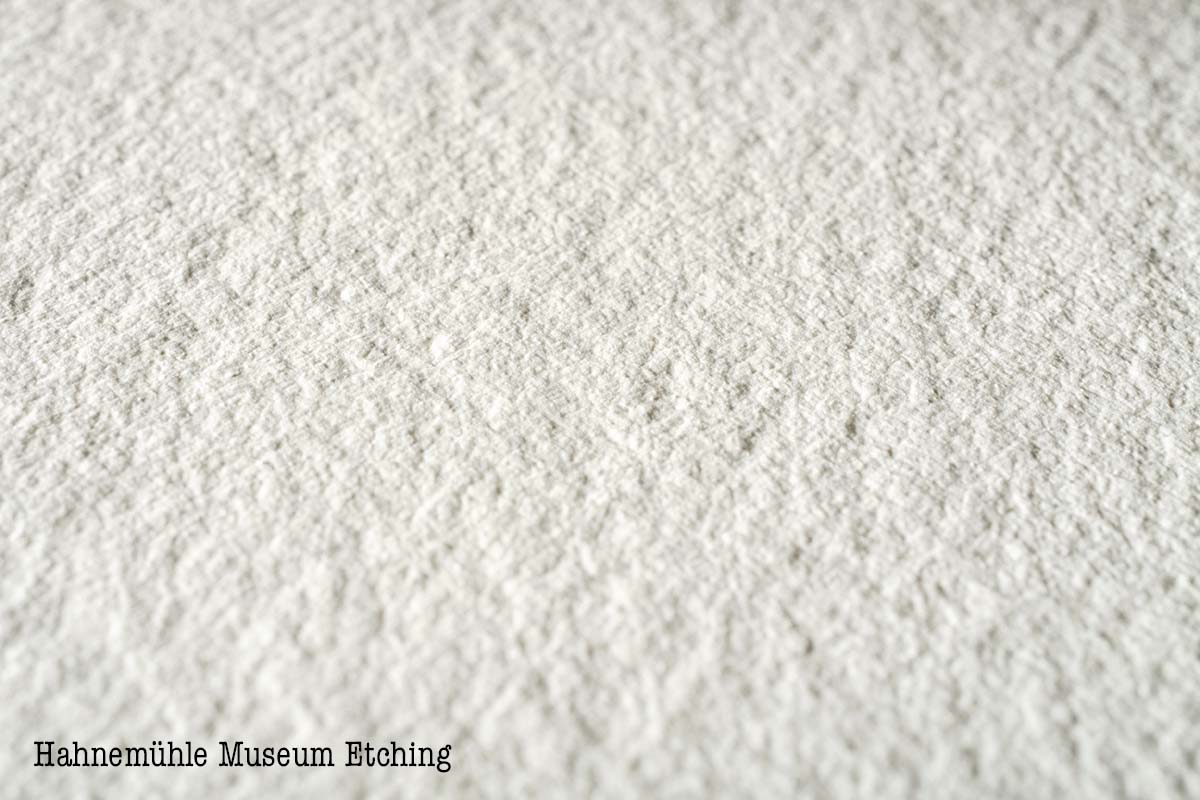
Holy Moley, Batman...that is one rough surface. A definite lay and pattern to the Albrecht Dürer and enough texture to break any image into a pastel drawing effect.


Okay, if Dürer was a German artist who made etchings düring* the Renaissance, who was Torchon? And why did he draw on something that looks like the side of a barn? Turns out a torchon is a French tea-towel, which explains this surface perfectly. Is it too silly to suggest that you should print pictures of French food on this paper?


German Etching suggests monochrome images with sharp delineation and serious subjects. My experience with it was tempered by bad language and the realization that paper has a mind of its own - a mind that can be changed by heat and humidity. It can also be bent into shape to counteract these tendencies.


William Turner was a Romanticist landscape painter and I am wondering if the naming of this paper may unconsciously lead to photographers utilizing it for images that feature rain, steam, and speed. Will they be committing images to preset plug-ins with brush strokes. Will they turn the Gaussian blur up to 139? Of course we will...


Museum Etching is similar to German Etching but not quite as edgy. If you print a fair amount of your output on this paper - and it is available in quite large sheets - you can invite girls up to see your etchings. I did, and it just shows you what my social life is like. They came up and wanted to see etchings...


There is no disguising the cloth pattern evident in the Monet Canvas sheets - it would be an ideal choice for the sort of art image that one wraps around wooden frames for wall display. Hahnemühle themselves make kits to allow this sort of thing to be done. The kits are very good value and if you can put good colourful images on them you can sell them for a good price. Then you'll be in the Monet...

Not every image suits a rough surface, and not every printer will handle these papers. You need one that can be set so that the paper moves in and out of it on a straight, flat line. You may need to bend or steam the papers to get them to obey. But the artistic effect on the right image is magical...and when you get the trick operating right you can produce print after print the same way.


* I cannot be fürtive about it. I like the ümlaut key. It's fün to üse... 


Labels: , , , , , , ,

Monday, November 21, 2016

Photographic Preservation


There is nothing more distressing than coming across historic images that have been badly damaged by poor storage and handling.

 The papers and emulsions that made up the bulk of photographic records of last century were sturdy enough things to start with but when people failed to take care of them they frequently did not survive the lives of their subjects.

The autochrome on the top of the post is an example -the original plate was made with multi-coloured grains of starch that were dyed dufferent colours and then exposed through a tri-colour filter pack to yield some of the first colours shots. Unfortunately starch is ideal for the growth of mould if there is a damp and warm atmosphere. And it is nearly impossible to remove it without losing the image.


It's not just a matter for the antiques either - you can find paper prints from just a few decades ago that have been left out in the sun, or marked with stains and careless handling in every family photo shoebox - frequently they contain real information that you want but the condition has beteriorated past all saving. And the notorious sticky-sheet albiums of the 1970's and 1980's proved no better.

I will say that the manufacturers of the materials did not help in the mid part of the century. The Kodachrome slides stayed very well, and we can all be grateful for the fastness of the colour of both the original Kodachrome A and the improved Kodachrome II. But the Kodacolor films and particularly the Kodacolor prints avaiable in the 50's contained dyes that have proved so fugitive as to defy even the best restorative programs on the Epson scanner or the computer programs.


Really, when you see the sorts of problems that occur for the dedicated historian or just the family picture collector, you really do have to thank your lucky stars that we are shooting digital these days. We just don't have these sort of problems.


Labels: , , , , , ,

Tuesday, July 19, 2016

The Bargain Harman For the Prudent Printer


Normally when I receive goods into my studio for illustration I finish taking the pictures and then carefully repackage them for return to the shop. In the case of this box of Harman Crystaljet Lustre RC paper I might just pay them for it and keep it for the production room. It is that good.

I have used a number of Harman papers before - including a box of this type some time ago-and I am impressed with the way the surface takes the ink and with the fidelity that it has to my screen.

I know the colour management and printing experts scoff at this and say that I should be able to minutely adjust the computer, screen, printer, paper, and ink with scientific formulae and careful measurements so that I could get an award-winning panorama on toilet paper. I must put in the hard yards - when the going gets tough the tough get going - and a calibration in time saves nine. Rah rah. I just want to poke a piece of paper in the Epson R3000 and get a good print in one pass. The Harman will let me do this.

I am at a but of a loss to know quite why one paper is a smooth pearl and another a lustre. And another a semi-gloss. They all break up the light a little and they are all pretty forgiving of most of the types of image that you may put on them. If you can't afford to keep racks of paper choices, get one of these and make it do.

The good thing about the harman is the price - under $50 for 100 sheets of A4. If you addicted to test prints and go through a great many evocations before you finally accept her result, this means you get about 40% more shots than with comparable papers from other sources. If, like me, you are sneaky and do your test prints on an A4 by quartering it and passing it through the machine 4 times:


You can go even further. That's Dr. Sun as a statue in Singapore.

But you have to candidly admit that the process of colour printing with the inkjet is nowhere near as arbitrary or confusing as the CYM subtractive printing of the RA 4 chemical era. If you could manage that, you can print on an inkjet with one eye closed and the other reading a novel.

Harman Crystaljet in store right now.

Labels: , , , , , , , , , , , , , ,

Friday, July 15, 2016

Sticking Together Through Thick And Thin - The Photo Glue Saga


One of the first important responsibilities we encountered as children in kindergarten was the glue pot.

No matter whether you found it in Europe, Britain, Canada, or Australia, it was the same thing - a big glass jar filled with something gelatinous and stoppered with a lid that never fit. Frequently there was a brush thrust through the lid. It was sticky on the inside and sticky on the inside and exuded an odour of strange chemistry.

We all tried to eat it at some stage of the game.  Wise schools invested in non-poisonous types...

As photographers we have also dabbled in glues - from the clear mucilages in bottles that we stuck pictures into albums with through various specialist formulae in tubes and then on to spray cans for bigger prints. Some stuck, some didn't - some ruined the photos and some left them untouched  - it really was a by-guess-and-by-gosh situation for amateur shooters.

Professionals had their hot presses and sheets of varnish tissue that they could use to mount large prints to matte boards. These were reliable if served with good materials and a degree of skill, but could ruin a print in 30 seconds if you got any grit trapped on the platen. Plus they were hot - and big - and expensive. And the materials to mount with them also cost a fair bit.

Which brings us to the subject of the post - the Hahnemuhle Archival glue in a 4 oz. bottle. The stuff is more than just a Bunnings bottle - it is pH neutral and will not come boiling out of the frame to wipe your work off the canvas or paper. Unfortunately you cannot say that about many other products - slather them on and watch in horror over the years as they let go and everything falls apart or start to turn all sorts of colours and shapes.

 As a model diorama builder I am keenly aware of the different reactions that glue and adhesives undergo when they are being used on different materials. I have watched careful work disappear under chemicals exuded by cyano-acrylates  years after assembly. The awful part about this is that the parts may be welded for eternity with the contamination locked inside the structure - short of sawing it apart you can't get in to clean up.

A side issue was the discovery of the effect of humidity and the expansion and contraction under  print display conditions.  This robbed one of my exhibitions of all dignity a few years ago as matted prints twisted themselves into Dorito shapes and fell off the frames that were displaying them. Subsequent years saw different glues and tapes tried , and in the end the best mounting turned out to be pinning unmounted prints to a hanging muslin backdrop.

Any rate, come into the shop and browse in the Hahnemuhle section. You'll find Gallerie Wrap canvas kits and frames as well as the 4 oz. glue and Hahnemuhle mounting spray. It's the spray glue of choice for a number of professional client and they go through a good deal of it.

Labels: , , , , , , , , , ,

Monday, June 6, 2016

When To Use A Pro Lab - 350 Reasons


The new digital photographer can be forgiven for being confused by any number of aspects of the sport - there seem to be so many to learn.

He or she used to be confronted only by which film to use, does the orange needle match the mark on the light meter, and is the Chemist open so that I can drop my film in? Then in two weeks it was should I buy another roll of film or a bag of barley sugar and box of bandaids?

Now it is white balances, tonal curves, video frame rates, colour spaces, and all the rest. No wonder they have started putting an " Automatic " setting on new cameras and dedicating a knob or lever to it. The relief for some shooters must be palpable.

It is nearly the same for the shooter who wants paper prints of their work. What do they do now that the chemist has gone out of photofinishing and reverted to selling overpriced vitamin supplements and something for the weekend? What are the alternatives with that card full of images?

a. Print it yourself at home on a multifunction printer from Officeworks. No, please - go ahead and do it. The printer will only cost you a hundred bucks and you'll be so disappointed with the results that you won't even have to buy expensive ink cartridges later to try again. The larger multifunctions make attractive pots for cactus.

b. Get Officeworks to print it for you on their big machine. This sometimes works to some extent if your file is perfect and your need is modest. Do not expect art. They are not going to correct your flaws. GIGO.

c. Get an Epson photo-quality printer and do it at home. This works. Start off with the Epson Surecolor SC-600 and move up to the SC-800 if you want larger prints and cheaper ink. Then cast your eyes at the even larger range of large format printers from the company. They will not be cheap but their quality of print is professional and you can be sure that the prints that emerge with K-3 ink on quality Epson, Ilford, Permajet, or Hahnemuhle paper will be be permanent and accurate.

But sad to relate, you are still going to have to be doing a good job with the files. You'll be telling the computer what you want, but you'll have to make sure your monitor is showing you the truth. ( Hint: Spyder colour calibrators, EIZO screens...) And you'll have to make sure that the computer tells the printer the right thing to do ( Hint: either, you, the computer, or the printer will have to manage the colour. Decide early.) And you'll have to make sure that the printer knows what paper you're using ( Hint: paper profiles.)

You will also need to ensure that you put the paper in the right side up. Do not ask this writer how he knows that. Take it for granted that he knows...

A little unsure about all the settings and alternatives? Then you need the Automatic solution...

d. Take the files on a hard drive, CD, or memory card to a professional photofinishing lab. They have not disappeared with the advent of digital - in fact the good ones are going strong because they are the good ones. And they are resourceful, technically skilled, and helpful.

A visit to a professional photofinisher like Fitzgerald Photo Labs at 350 Fitzgerald Street, North Perth
is almost as easy as it used to be to put your films into the chemist. There are real people there who can look at your files and advise you on the optimum sizes that they can be printed. They can suggest paper surfaces for larger works. They can frame the bigger prints - and there are so many options for modern display that you can never run out of a fresh decor idea.

They are able to handle film needs as well - lots of people still shoot on film - and converting the negatives and transparencies to digital files is easy these days. You can get your work back in dual form - digital as well as paper print.

Again you can be sure that the pictures you pay for will be permanent. The big labs use Epson K-3 ink on their big machines.

The joy of a big lab like Fitzie's is that the printing people are there to talk to you and they know what they are doing from long experience. It is not just machine minding in a large furniture or discount store for them. Their job is a profession and they produce professional quality - and that's why Camera Electronic depend on them for our advertising banners and promotional prints. These need to be right and they ARE right.

For those of you  point out that I have forgotten the discount store and the furniture shop...well I remember them when I need tee shirts or kitchen chairs. But not when I need good quality photofinishing.

Labels: , , , , , , , , , , , , , , , , , ,

Wednesday, September 16, 2015

Epsonnews - Money Is In The Pipeline


Two good bits of economic news from Epson - makers of fine inkjet printers, inks, and media.

1. The cash back offer to purchasers of Epson Stylus Pro SP-4900 printers has been extended. From the 15th of September to the 31st of October 2015 you can receive a $ 500 cash back from Epson on these fine devices. Of course you have to buy it from a dealer - like us - between these two dates, but all you have to do is contact them online after you have your printer and let them sight your serial number and invoice.

The 4900 is a very sophisticated A2 roll and sheet printer. It can produce all day, every day.

2. You can also participate in the Epson cash back festival by purchasing one of the new Epson SureColor SC-P600 inkjet printers between the 15th of September and the 15th of November 2015. In this case you do the same proof of purchase to Epson and receive $ 300 cash back.

The SC-600 would be ideal for the home printer and enthusiast. It can take roll paper, sheet paper, CD's, and produces prints up to A3+. Of course if you use the roll paper feed you can make looooong panoramas as well.

These printers are easy to use - I know because I use an R3000 at home  - and the results are delightful. And inkjet printers are perfect for one-off fast print jobs; you can be in and out of the computer room with a new A4 print in under two minutes with no cleanup, travel, or traffic time. Think about that next time you are stuck on the road at 4:30 in the afternoon...

Labels: , , , , , , , ,

Monday, August 17, 2015

Well, I Was Wrong. And It Cost Me Money.


But that was a long time ago.

I was using a well-known name of SLR camera with well-known film. And a simple set of lenses - f:1.8, f:2.8, f:4. My slides were taken out in the open air and at medium f stops and about 1/250 of a second. And they were sharp and well-coloured.

As photography enthusiasts go, I went, and like many others was not satisfied with success. I lusted after the LX version of the camera and when I got it decided that the 55mm f:1.8 lens was not going to be as good as the 50mm f:1.2. So I traded it in and got a couple of boxes of colour negative film, and went out to take pictures in the twilight.

Not surprisingly, when I got back the results there was more grain in the image, the focus was not as sharp, and the postcard prints had none of the sparkle of the transparencies. I just knew it was the fault of the camera and the mens and sold it all off in a snit to buy the next hare-brained idea - a medium format press camera.

Older readers will detect where I went wrong - f:1.2 is not as sharp as f:8. Low light levels and shadows mean muddy shadows. Negative film has more grain than transparency film. Minilab prints can sometimes be minimal quality. But I convinced myself it was the fault of the camera.

Now I work in the trade and have taken more photos and looked at them. I realise my mistake. I spent out big and spent out wrong because I did not talk to someone in...the photo trade.

Labels: , , , , , , ,

Thursday, August 13, 2015

Lustre, Semigloss, and Smooth Pearl - The Paper Cuts


Okay, I can tell the difference between these if I look hard...but if the various manufacturers come out with new surfaces like Semi-Lustre, Semi-Semi-gloss, and To A Certain Extent  Smoothish Sort Of Pearl I am going to just take the box nearest the front and whack that into the printer. If I am feeling fussy I'll put it in the right way up and if not I'll just stand at the door and throw the box at the machine...

You can still get sample books for paper surfaces and colours from various makers and sometimes they are a help - however paper development can leapfrog past their own publicity and sometimes the books fall out of date. And sometimes the images in the books seduce us into believing that our own pictures will look as good, but then leave us standing.

This isn't a new phenomenon- the old darkroom paper books from Ilford, Agfa, Kodak, Ansco, Seagull, Gevaert, etc. were mostly black and white but could exhibit such a variety of effect for surface and colour as to fill any professional need. Some papers were bizarre - witness the silk pattern surfaces and some of the heavily swirled ones. There were artistic reasons for it, as there are for heavily textured inkjet papers, but these were few and far between. Mind you, we all tried them and as fate would have it, some of the best portraits of people we love are seen on these odd papers - if we have lost the negatives we are left with just the oddities.

Commercial considerations often dictate the surface for giant inkjet prints - in some cases canvas is the material of choice. Artists sometimes favour matte surfaces to suggest watercolour paper. Technical prints may benefit from a high gloss.

The default paper, though, probably is some sort of a slightly broken clear white. Ilford, Hahnemuhle, Harman, and Permajet all make something of this nature, and if you wish to print A2, A3+, A3, A4, 5 x 7, and 6 x 4 there are ready supplies in bulk.

Indeed - sometimes there are great bargains - once a year Ilford used to give from 5 to 10 free sheets of their standard papers in special packs at the regular price. Right now we have Harman A4 in 100 sheet boxes for under $ 50. If you've a printer and are a Printer, come visit.

Labels: , , , , , , ,

Tuesday, October 7, 2014

New Paper Packaging For Hahnemuhle


I was quite taken with the new packaging for Hahnemuhle papers - here you can see the really really big size for really really big images...

Unfortunately there are no inkjet printers big enough to take this size here in the shop just now, but we do have similar-looking A4 and A3+ packages. And we have A3+ and A2 printers and plenty of ink.

Hahnemuhle is premium quality fine art paper in a number of professional finishes. With the correct profile and colour management it makes ravishing prints.

Labels: , , , , ,

Carton Special Of Ilford paper


"Tis a far, far better paper I buy - and a far, far better print I will be making - than I have ever known..."

Okay, Sydney, we'll take your word for it. Off you go up the stairs. Don't forget to take your carton of Ilford Galerie Prestige Smooth Pearl A4 paper with you.

It will contain 4 boxes of 100 sheets each - that's 400 perfect sheets of paper for your inkjet printer and you'll get it for $ $ 290. Revolutionary!

As this paper is normally sold at $ 85 per 100-sheet box, that will be a saving of $ 50.
You'll be making a Dickens of a saving there...there will be enough paper to print everywhere - even in two cities, if you want to...

Mind you, be sensible. No need to lose your head. We've got plenty of paper.

Labels: , , , , , , ,

Friday, October 3, 2014

Epson Money Train Ready To Go


One of the most addictive and attractive video games at the Sydney Star City Casino used to be something called The Money Express. Whether you ever won anything or not*, it was worth feeding dollars into it just to see the graphics on the screen.

Well, Epson also have a Money Express starting up this month. They are offering a cashback for their Epson Stylus Pro R3000 inkjet printer. The scheme started on the 1st of October and is running until the end of December - just in time for the Christmas season.

Basically, you purchase one of these fine A3+ printers here at the shop, then contact Epson on-line with the serial number and date of purchase. They send you back $ 300.
 Simple as that.

Then you grab some Ilford Galerie Smooth Pearl A4 paper from us - at a bargain price - and print until your family begs you to stop**. The printer is a smooth performer - I have one in my computer room as well as one down here at work. Four keystrokes on the average file and a minute later you have an A4 picture or advertising sign. You have no idea how comforting that is down here...

The printer does not take up a big footprint - it does not make a lot of noise - it does not shake from side to side - it does not suck up a lot of electricity. And now you get $ 300 back in your pocket.

Reach for your wallet.

* And you never did...

** And you never do...

Labels: , , , , ,

Tuesday, September 16, 2014

Good Laud - We List the Canon AIPP Annual Awards


The annual event that Canon and the AIPP conduct to examine and display the work of Australian photographers has just been concluded. There are a number of divisions in which they consider photography can be divided and there are awards for the leading Australian practitioners - and one for an international person. It's a big ist, but the people who make it are the best for this year - take it as a good hint to look up their work and see why they have received the plaudits of their peers.

If you're in the market to hire anyone for photography...well this is also a pretty good shopping list of people - but remember that you're looking at the Paris end of Collins Street...

So, to the list. Please note that the Canon company's name is linked to the AIPP in each case.

1. Canon/AIPP Australian Photographer of the year - James Simmons
2. Canon/AIPP Creative Photographer of the year - Kirsten Graham
3. Canon/AIPP Wedding Photographer of the year - James Simmons
4. Canon/AIPP Family Photographer of the year - Kelly Brown
5. Canon/AIPP Portrait Photographer of the year - Peter Rossi
6. Canon/AIPP Illustrative Photographer of the year - Keren Dobia
7. Canon/AIPP Birth Photographer of the year - Victoria Berekmeri
8. Canon/AIPP Documentary Photographer of the year - Anthony McKee
9. Canon/AIPP Science, Environment, Nature Photographer of the year - Joshua Holko
10. Canon/AIPP Landscape Photographer of the year - Ricardo Da Cunha
11. Canon/AIPP Travel Photographer of the year - Nick Rains
12. Canon/AIPP Sports Photographer of the year - Matt Palmer
13. Canon/AIPP Commercial Photographer of the year - Aran Anderson
14. Canon/AIPP Fashion Photographer of the year - Peter Coulson
15. Canon/AIPP Advertising Photographer of the year - Matthew Everingham
16. Canon/AIPP International Photographer of the year - Luke Edmonson
17. Canon/AIPP Photography Book of the year - Peter Eastway
18. Canon/AIPP Album Photographer of the year - Nadine Saacks
19. Canon/AIPP Australian Tertiary Institute of the year - Photography Studies College
20. Canon/AIPP Emerging photographer of he year - Adam Williams
21. Canon/AIPP Student Photographer of the year - Jacqui Hogan
22. Canon/AIPP Highest Scoring Print - Kelly Gerdes

Thats a powerful lot of awardin'...

I noted the category of Birth Photographer and wish to accord Victoria an especial degree of respect. Never mind all the other camera businesses - she is the one in this list that is concerned with the essential part of life - and it is a tough time for everyone in the place. If she can cope with new babies, new mothers, new fathers, and old theatre sisters and get the top spot for Australia she is the star at the top of the tree as far as I am concerned. Yay!

And congratulations and an increase of business to all the other winners.


Labels: , , , , , , , , , , , , , ,

--> Camera Electronic

Camera Electronic