Monday, April 17, 2017

The Digital Shotgun - Or The Art Of The Bracket


A recent weekend spent playing with the new Olympus OM-D E-M1 Mk II showed me how useful it would be for macro work and studio product illustration. This column showed some of the ways that the focus bracketing and focus stacking features helped to tame the problem of depth of field. Kudos to Olympus.

Also, my foray to Jandakot airport showed their long telephoto lens and their superb image stablising systems making short work of long-distance coverage in bumpy conditions. Instant desire to own one...and a very successful DIY job done.

But like every successful DIY job, once the thing has been accomplished, you should put away the tools, clean the workbench, and throw away the rest of the pot of red paint that you bought to do the project. But we never do - we look around for something to use up the paint on...

Olympus have lots of buttons on their new mirrorless camera that attract the idle finger. One of them is the one that sets up bracketing - in this case art effects bracketing. One press on the shutter button and the device takes off into a series of interpretations of the scene, stacking them into JPEGS.
Hi-Key, Low Key, Dramatic Contrast, Sketching, Soft Focus, Hard Focus, Monochrome, etc. etc. I think there was Diane Sauce and/or Ennui there in the settings somewhere...

Here are some of the results. I offer them with no comment, other than to say they are well done. If I understood Art I would probably appreciate them more. If they remind you of the results that a bored teenager gets with a mobile app and Instagram, reflect that a bored retiree would be even worse.


There is a good side: If one of these artistic decisions accords with your own vision of the world, you are onto a winner. In that case the camera will do what you want to do consistently and will show you what the results are going to look like out there in the field while you are still shooting. You might be the sort of person who revels in vast long sessions of Photoshopping your images to produce the same effects - in which case we suggest that you shoot RAW and then beat the thing to death yourself. But if you just want it now, this Olympus feature is a good one.

Note: I am also guilty of two-hour Photoshop sessions with forays off into Alien Skin and Nik plug-ins to alter the images. I've got some corkers - but some of the best ones have far exceeded the history feature of the program and I cannot reproduce them again. At least if the Olympus camera gets you into the artistic ballpark, you'll have less smearing to do in the end.

Labels: , , ,

Thursday, January 26, 2017

The Giant Economy Size


We sell lots of things in Camera Electronic that are intended to be small; Olympus cameras, Gitzo traveller's tripods, Metz LED lights. But we also sometimes lash out and get the Giant Economy Size. Case in point: The Premier Eco Print Shield cans.

These are a liquid coating for your inkjet paper and canvas prints that will stop the UV rays from messing with the colours - they also stop airborne pollutants and moisture from ruining the surface of the print. This may not seem important if all your pictures are on your iPhone or 6 x 4 postcards in a shoe box...but the big boys and girls who print out on large format printers and frame their exhibition work know different.

Now the statement that something stops UV damage completely is a difficult one to make - particularly in Western Australia where we manufacture ultraviolet radiation for export. You have only to listen to the weather reports every day to realise that our WA UV index scale starts at " Extreme " and goes up from there. About the only complete UV protection for anything is to put it inside the turret of a Sherman tank and close the hatch...

But the Premier Eco Print Shield does help. It can make the difference for an interior display between a year's safety and 5 years. If you are selling your work, that is important...it gives you time to get away.

Two finishes in stock - Matte and Satin, and you can spread it with bush, roller, or spray gun. If you choose the last mode of delivery you will need a gun with a wide throat to get this solution out...and make sure that you clear and clean your gun between applications. This is thick stuff.

If your needs are more modest, there is also the Hahnemühle spray in aerosol cans - some pros rely on this exclusively.

Note to those people whose entire portfolio is on their iPhones, iPads, or the 8-year old computer that seems to be a little slower at booting up these days...Start to print out some of your best work. The thrill of seeing it in the hand and on the wall is reward enough for your trouble. And people will think of your output in more concrete terms when it is hanging off the concrete.

Plus...for those with the entire portfolio on the Fisher-Price My First Hard Drive...remember the old Bond's underwear ad slogan..." One day, you're gonna get caught..".


Labels: , , , , , , , , , , ,

Thursday, January 19, 2017

The Paper Shuffle - Part Four - Rough Justice

 
Life is not all smooth and sleek in Dassel, Lower Saxony, and neither is it in the Hahnemühle factory. At least not in the division that makes the Matt Fine Art - Textured inkjet paper.

I don't know if the firm chops down chunkier trees or employs rougher workmen, but the results have a rugged charm all their own. Prepare to pick your way through a plowed field of paper. Mind your ankles.


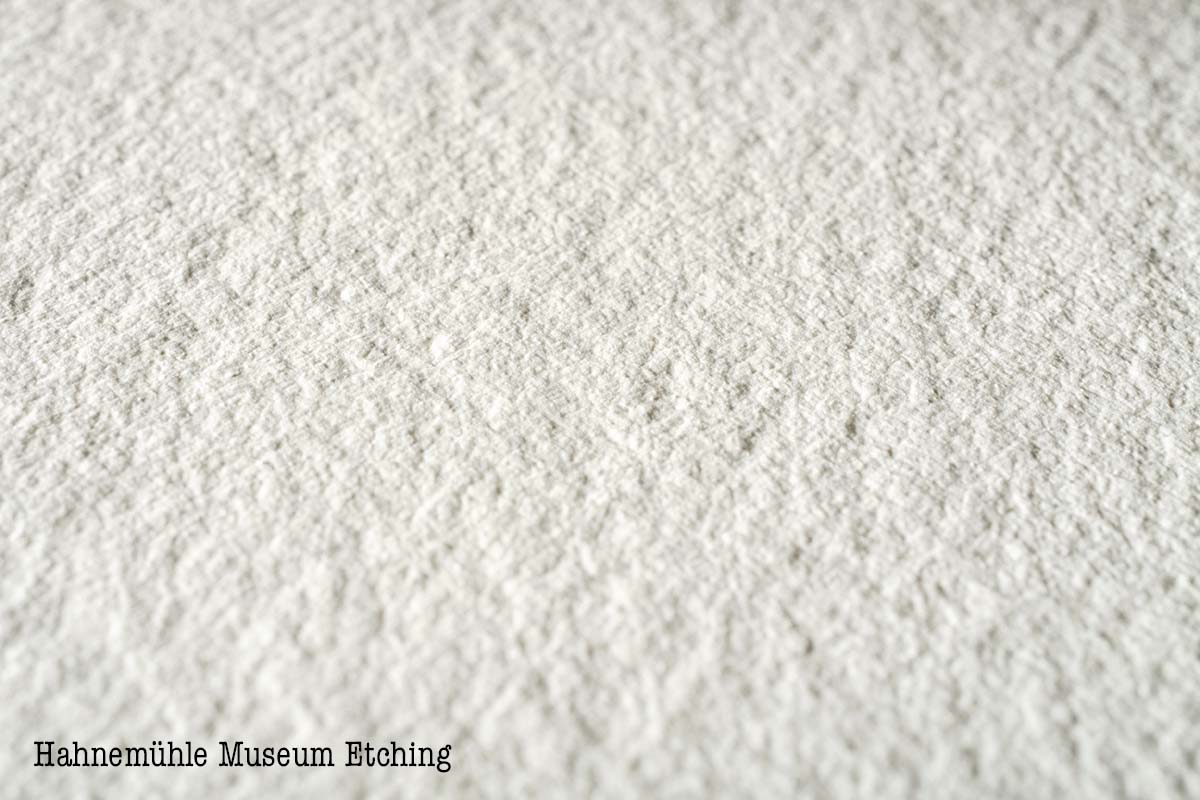
Holy Moley, Batman...that is one rough surface. A definite lay and pattern to the Albrecht Dürer and enough texture to break any image into a pastel drawing effect.


Okay, if Dürer was a German artist who made etchings düring* the Renaissance, who was Torchon? And why did he draw on something that looks like the side of a barn? Turns out a torchon is a French tea-towel, which explains this surface perfectly. Is it too silly to suggest that you should print pictures of French food on this paper?


German Etching suggests monochrome images with sharp delineation and serious subjects. My experience with it was tempered by bad language and the realization that paper has a mind of its own - a mind that can be changed by heat and humidity. It can also be bent into shape to counteract these tendencies.


William Turner was a Romanticist landscape painter and I am wondering if the naming of this paper may unconsciously lead to photographers utilizing it for images that feature rain, steam, and speed. Will they be committing images to preset plug-ins with brush strokes. Will they turn the Gaussian blur up to 139? Of course we will...


Museum Etching is similar to German Etching but not quite as edgy. If you print a fair amount of your output on this paper - and it is available in quite large sheets - you can invite girls up to see your etchings. I did, and it just shows you what my social life is like. They came up and wanted to see etchings...


There is no disguising the cloth pattern evident in the Monet Canvas sheets - it would be an ideal choice for the sort of art image that one wraps around wooden frames for wall display. Hahnemühle themselves make kits to allow this sort of thing to be done. The kits are very good value and if you can put good colourful images on them you can sell them for a good price. Then you'll be in the Monet...

Not every image suits a rough surface, and not every printer will handle these papers. You need one that can be set so that the paper moves in and out of it on a straight, flat line. You may need to bend or steam the papers to get them to obey. But the artistic effect on the right image is magical...and when you get the trick operating right you can produce print after print the same way.


* I cannot be fürtive about it. I like the ümlaut key. It's fün to üse... 


Labels: , , , , , , ,

Wednesday, August 24, 2016

The Frame Up Job


At the risk of sounding like a Me-Too blogger, I wish to draw attention to a course being run by the Shoot Workshops next door. It is a workshop on Picture Framing and will be run by Aaron McPolin on Sunday, the 4th of September - not that far into the future.

The workshop costs $139, but this is the sort of thing that just does not come along every day. In fact, I would be prepared to say that in Perth this does not come along ANY day. It is the chance of a lifetime for some of us.

We all make files. We all make images. Some of us make pictures. Few of us make pictures that hang on walls. And damned few of us make pictures that deserve to hang on the walls.

Part of this is the files, part of it is the images. After that a great deal of it is the aesthetic that either supports or condemns the image. Here is where Aaron may be able to offer the insight to help us improve our pictures.

The blurb for the workshop speaks of colour theory, printing for longevity, placement, glazing, and matting. Also lighting, placement, exhibition design, and pricing. Even if you are not trying for " Family Of Man " and would settle for the relatives spread out over the lounge room wall in reasonable order, this workshop is going to help.

I freely admit to not being an artist, and have had this firmly attested to by Perth Artists on Facebook, but I think that this sort of thing will help me to improve my taste and present my work better. I have an ambition to be rejected by a better class of gallery than Facebook, and this may help.

Studio 281
281 Guildford Road, Maylands
Sunday, 4th of September
10AM - 4PM

Contact Shannon at Shoot Photography Workshops to make a booking:

T. 08 9228 8232
E. shannon@shootworkshops.com.au
W. www.shootworkshops.com.au


Labels: , , , , , , , , , , , ,

Monday, August 15, 2016

Brush, Palette, Mouse....Ready For the Louvre


Last year I was black-balled from entry into a Facebook group of artists - condemned for being an "events photographer". I suspect it was also because I was unable to speak Artish and would not get a tattoo or a man-bun.

Whatever, it set me out on a quest to become an artist in spite of the critics. I thought long and hard about what art I would pursue. Making miniature scenes was all very well, and taking pictures of weddings and hot rods and pretty girls might be a good training ground, but something more was needed. Something that would say Art loud enough and in a condescending enough manner to allow me to sit in a coffee shop and fill out Centrelink forms...What to do...What to do...

Then I had it. Digital art. Prints derived from images that I have taken, suitably modified until either they resemble other media or I resemble other artists.

Armed with that determination I ordered this book:


Focal press books are generally good, though they have had some authors who seem to have spent too much time in coffee shops filling out Centrelink forms. But in this case, Susan Roddick Bloom seems to have hit upon just the right level of communication to help the novice. And fortunately , Camera Electronic equipped me with the rest of what I needed.

Of course, I needed the images in the first place, and I've a Drobo full of them. And a Wacom Intuous tablet - CE had those too -  and a new iMac computer. I also had the Epson printer I got from CE and it is calibrated with the Spyder Express, so I was nearly all set. Final piece in the chain was the image editing program...and I went with my faithful Photoshop Elements 14.

It proved to be a good choice. Ruddick's book is several years old, but the basic procedures that she outlined in Photoshop itself are now quite do-able in the latest Photoshop Elements. There have been no procedures or techniques mentioned in her text that cannot be done in PE, and very few of the references she makes to specific things need to be translated to another wordage. Adobe have been decent enough to keep the same things in the same drawers in the digital desk.


Ms. Bloom covers sketches, pastels, cont, oils, watercolours, and illustrations. She has a chapter on some of the commercial plug-ins that also simulate drawn art...and she is not too prissy to admit that they can be a good jumping-off point for fast starts. I've tried a little from many of the chapters and found her advice to be excellent. it was money well spent.


The Photoshop Elements 14 program was also money well spent - and if you are at all interested in getting into digital shooting and manipulation I can recommend it.


Now it will be a case of experiment, practise, and time. One day I hope to be refused entry into ever more prestigious art groups. If I can be ejected from the Hermitage, Tate, or MOMA I shall consider myself a success.

Uncle Dick


Labels: , , , , , , , , , , , ,

Monday, June 20, 2016

The Amateur Triumphant - Part Three


Well, you've finally done it - closed the doors of the professional practice and sent a farewell notice to the ATO. You've tossed the letterhead, invoice forms, and business cards into the fire and told the accountant that you will be doing your own lying in the future. You are set to be a real amateur.

No turning back. No doing jobs for money. From now on the only compensation you will be receiving will be "exposure", "a drink", and "recognition". And the occasional bucket of lemons from Mr. Valducci's tree. There will be more lemons than drinks.

The demands on you will change - while no-one can compel you to deliver the goods on time, they will expect you to hand over every raw file that you have taken so that they can have them printed at Officeworks. This might have seemed unreasonable when you were a working professional but that was when you were a person with a camera in hand - now you are a camera with a person attached. The camera has remained sharp but you have become fuzzy.

Do not despair. While you no longer will have money, you can still have fun. By all means turn over the raw files to the person who demands them. Just copy them all into 1993BFG.3.0PiX format on a 5" floppy disc and hand it over. And a pleasant smile when you do so doesn't hurt.

Your own photography will improve greatly in the future. You will no longer be asked to make tins of cabbage ends or anorexic teenagers look appetising. No one will ask you to take 3.2 metric tonnes of lighting equipment up the top of Bluff Knoll in relays to capture the magic of toilet paper. You can go to a wedding and drink.

Better still, you can go to a wedding and watch the wedding photographers at work and let them watch you watching them. If you know how to let out good strangled shriek or do a very slow face palm you can have fun all afternoon. A slow wink also does the trick.

Are you worried about the piles of gear that are still stacked in the locked cabinet? Well, if you haven't finished paying for them you need not worry too much longer. The leasing and finance companies will be sorting that/you out in short order. If it is yours freehold, you can either use it to take immensely detailed photo essays of spit or you can take it to the camera markets that they hold every three months. You can then bring it home again.

There is an opportunity for the new amateur to join the art scene. This can be effected on-line or in person by attending at local art groups. Sociability, kindness, and the ability to see good in everyone is an asset in this sort of affair. It is rewarding if you are prepared to learn the language of Artspeak and are not afraid to try a few halting phrases. " Awful Dreck " and " Ghastly Daub " are useful...

Finally, have you thought of finally settling down and writing the Great Australian Novel? Or the Definitive Outback Photoshoot? Or setting fire to paddocks? They are all equally attractive propositions, and as you are a free agent you can turn them over in your mind...

Onward. Excelsior!

Uncle Dick

Labels: , , , , , , , , , ,

Thursday, March 17, 2016

Attention All Artists And Artisans - Your Straps Have Arrived


Three more flexible delights in at the receiving desk this week: Artist and Artisan straps. These will be the final touch for careful camera owners.

The first style is the romantically-named ACAM 301.


It is a woven neck strap in black with a round profile - roughly 9 mm diameter - featuring black leather ends. These are sewn in as well as glued onto the round cord and will take the strain of the heaviest portable camera. Round SS attachment rings.

The second strap is the ACAM 295. It is a wrist-fit rather than neck strap


Here the profile is a flat strap in red material - 22mm wide. There is the standard SS spilt ring held in a black leather end piece with a camera protector flap as well.

The third newcomer is also a wrist strap - the ACAM290.


Black leather, 9mm wide and 3mm thick, it is formed from two pieces double-stitched together.Again there is a SS ring, leather end piece, and camera protector flap. It is packaged in a bright orange box.

I'm not sure if art is better served by the use of these straps, but they are certainly a better looking alternative to slinging your Leica round your neck with a piece of baling twine. Perhaps they just make you look better.

Remember to always search for these and other fine A&A products in our on-line store.

Labels: , , , , , , ,

Thursday, September 24, 2015

Good Colour Bad Colour Ugly Colour


The days of putting our films in to the chemist and hoping for some decent prints in a fortnight are long past. We now put our memory cards into the card reader and hope for some decent images in 5 seconds. The time occupied by gnawing anticipation is reduced greatly but we have also lost the consolation of being able to buy a bag of barley sugar sweets even if everything is blurry.

Same with colour. We once got what we were given and liked it. Sometimes we got what we deserved. The cost of colour slide film or colour printing in the film era was considerable - and we did not waste our shots. But what came back was tied to the temperature and purity of the baths in the processor and that could be a mixed bag - and sometimes the technicians loading the machines got it horribly wrong. Ask me about the wedding that vanished...

Nowadays we can get our colour RAW and cook it for ourselves. We can take precautions to prevent all but the direst disaster. Most of our weddings and some of our brides survive. Of course we may be wrong with the colour - that is still a subjective matter for most shoots. We are aided by the mechanisms in modern cameras and can make use of Datacolor colour charts of various types. We can calibrate our monitors and printers and viewing lights and everything. We can desaturate everything and talk up the art of it...fancy footwork can save a bad situation. Try to show the prints in a dark restaurant after a few drinks...

In the end, we need to remember that we are not making real objects - we are making flat images of real objects. We can get 66% of the way to realism but that third dimension kills it. If we are not making a stab at realistic representation we can even throw the 66% away - as long as we can please the viewer.

 Remember that sometimes we can't  - Vincent van Gogh made a dynamite starry, starry night but nobody wanted to buy it then.

Labels: , , , , , ,

Friday, September 4, 2015

Save Everything - Whales, The World, Old Soap Wrappers, Jpeg's


Everything.

Save it on your computer drive, back it up to your Time Machine hard drive, then back this up to your Drobo, then burn CD's of the files, then print them out on an Epson printer, then rephotograph the prints with a 35mm copy camera and archivally process the film. Then store it in acid-free sleeves in a fireproof contaner.

Then take the discs and the film and the prints and any spare pixels that have fallen out of the back of the machine and put them in a safe deposit box down at the Bank of New South Wales.

You may want to ask the bank to sandbag the St. George's Terrace entrance and post guards armed with Stirling SMG's there - better safe than sorry.

After you have done this, go back and look at the images you started with. Are they really all that good? Is your student portfolio of 365 daily images of a banana on a plate really the stuff of your dreams? Have you advanced? Would it be a good idea to keep one picture of the banana and clean the rest out of the drive?

Just this thought occurred to me some time ago when I noted that the content level indicator on the Drobo drive I use got past half-full. Now the Drobo is a wonderful device for keeping things safe, as long as you keep it safe. I can re-disc it to far more capacity than it bears now...I'll do that eventually, but decided to look into the thing at present to discover what was in there.

Well, I didn't find the missing sock but I did find damn near everything else that I had dumped into it. Including jobs that had a set of RAW files, jpeg finder files, working psd files, and finished jpeg output files. Plus a few tiff's and something that looks suspiciously like a tram ticket. It was like an overgrown garden of pixels.

I set aside my ruth and weeded relentlessly - gaining back valuable disc space and concentrating each division into work that I am happy with. I did allow some wiggle room with RAW files that I may re-work...but even there I have been realistic with what was actually worth re-working. Let's face it folks, we usually get better as we go along, and it is retrograde to go back and try to make silk purses out of our sow's ears. They are never good and it annoys the sows.

Spring cleaning is not just for the carpet - try it and see.

Labels: , , , , , , , , , , , ,

Thursday, September 3, 2015

Click. Click. Clickclickclickclick.....


Some camera users are lucky - they get to do things that other people are prevented from.

Take for example the user of the large -format wet plate camera with the Petzval lens. Like you see at every football game down on the goal line...they operate their shutter by taking off the lens cap - or by covering and uncovering the lens with their bowler hat. They are not restricted to 1 second-1/4000 second exposures. They can keep their hat off the shutter as long as they like and get the whole game in. It won't be in focus, but then that's what you get when you support certain teams...

Likewise the users of some cameras that decouple mechanical shutters from film advance or electronic capture - they can overlay shot after shot on one frame. Done cleverly, it is science. Done randomly, it is art. Done inadvertently, it is modern art.

The users of the more mundane digital cameras have to do it differently - if they are locked out of multiple exposures by the camera design they have to take separate exposures and blend them in Photoshop. Do-able, and not hard.

Some DSLR designs will permit multiple shots on one frame. Be sure that if you engage this setting for artistic purpose that you disengage it when you are finished. Putting an entire European holiday on one frame of the card is probably not a good idea.

Note that one manufacturer makes multiple exposure provision that accommodates itself  to the measured light of the scene and divides the exposure accordingly. Set-piece and tabletop photographers can make some interesting effects using this.

Labels: , , , , ,

Wednesday, August 26, 2015

Two Sides Of Two Papers - New Ilford A4 In Stock


Sometimes the humblest of products can be exciting.

Witness the two new boxes of paper from Ilford - we received supplies of double-sided matte paper this last week:

1. Ilford Galerie Prestige Fine Art Smooth.

A4 size and 220 gsm. Smooth bright white on both sides. boxes of 25 with the gold label. Appropriate profile in the Ilford website.

2. Ilford Galerie Prestige Fine Art Textured.

Again A4 size and 220gsm. This one has textured bright white on both sides. and again there is an appropriate profile for it.

Ilford media is the standard of he industry for many applications - this matte paper and Epson, Canon, or HP inks and printers wold make very good art book and presentation material.

Of course there is always the extra concentration one needs when making anything double-sided - you need to be careful with borders and spacing and remember to get your orientation right before you push the 'print' button. I have made a number of errors in all these things over the time and it does teach you eventually - at a price.

In any case, these are not punishingly expensive papers - you can experiment and delight yourself.

Labels: , , , , , , , ,

Friday, August 7, 2015

1984 - George Orwell's Vacation Slides


What do Erich Honecker, Helmut Kohl, and these boxes of Agfachrome have in common?

They were all available in Germany in 1984. Erich's handed in his dinner pail, Helmut is in a wheel chair, but these slide films are just as good as they always were.

Of course, that begs the question of just how good the always were, and I am here to tell you that they weren't. I have a filing cabinet full of Agfa colour slides at home carefully separated and stored in archival sleeves. They are in a climate-controlled environment and are kept safe from UV rays, fungus, and insects. Nearly all of them are horrible.

The Agfa slide mounts of the period were great - blue and white plastic mounts with rounded edged and a sturdy profile. They were returned to us from the processing plant in Nunawading, Victoria in a good orange plastic box - it was a class presentation all the way. Kodak used cardboard mounts and difficult little boxes and you felt that you were getting second best...

Little did we realise that the dyes used in the Agfa product were fugitive, and would leave of their own accord, no matter how we stored the things. Most, if not all of the Agfa CT18 slides I have are decoloured - they are magenta-tinted and almost un-viewable. I can recover a little of the scene with digital colourisation, but never reliably and never well.

Bummer.

Well, we found six boxes of these little chromatic hand grenades at the back of a cabinet. They are unused, dated for 1984, and horribly tempting. The internet says that this film can be processed in E-6 chemistry but 31 years is 31 years and I suspect these contain as much art as science right now. Inadvertent art, if you will.

Make us an offer. Pull the pin on these and see what happens. Don't blame us if the owner of the mini-lab you try to process them in chases you through the streets with a pitchfork. We have no idea what will happen...

PS: No more Nunawading. Yer on yer own.

Labels: , , , ,

Tuesday, June 9, 2015

The Drones Club - Not Just For The Egg And Bean


If you are a reader of P.G. Wodehouse you'll recognise the reference. If it is all a mystery but you would like to know more about the art and business of using the UAV for photography - and the results that one expert has achieved - then we have a night for you.

A free night, as it happens. At Shoot Photography Workshops premises  - 232 Stirling Street, Perth. It will be held between 6:00 PM and 8:00 PM on June 16th. Thats a week from today - next Tuesday.

You'll be seeing the photographer - Christopher Fulham and his talk will be entitled " The Edge Of Photography. It deals with the real frontiers of digital photo practice.

Cinema drones - the UAV - and iPhones - the HHN - will be topics of discussion. But more than that - Christopher will be speaking on a broad range of subjects all concerned with working and surviving in harsh natural and business climates. Art from the air with the video drone and how to put money in your pocket from any number of related sources.

There will be refreshments and warm drinks - to match a cold night. Places will be limited, so give us an RSVP through the Camera Electronic website's " Workshops " page.


Labels: , , , , , , , , , ,

Thursday, April 30, 2015

Pictures At An Exhibition - Or How To Be Modest


As photographers we are rarely encouraged to take pictures of someones else's photographs when they are exhibited. It is considered naff in some cases and criminal in others - particularly if we then whack them on our websites and claim them as our own.

It's a little different if we go to see pictures that have been done by other means - or sculptures or artefacts and manufactured articles. Sure, there can still be a degree of  taboo, but many public galleries are okay with it - as long as you do not use flash or tripods.

This is fine - I love wandering the art galleries of Victoria and New South Wales to see famous works of art - and new, obscure things. I have learned to cope with the light conditions of the places and to get a clear result.

The illumination can be problematical, though good galleries will have directed lighting that shows the art to good advantage. But the colour temperature of it may be all over the shop. I've taken to recording the art with RAW and a small jpeg - the little one as a sighting rifle for he more detailed capture. I have also considered one of the tiny Spyder Checkr 24 colour cards for my travelling bag so that I can reference back to a neutral result later on my computer.

Flash is out - the galleries do not want to subject the works of art to the danger of fading or the cleaning staff to the danger of discovery...put your camera up to the highest ISO that will deliver a clean image for your purposes, and turn the image stabilisation on. Consider attaching a Steadepod to the bottom of the camera and stepping on the footplate whenever you need utmost stability.

Lens choice? Well, if you have a lens that has very little distortion in the first place - like the 23mm f:2 on my Fujifilm X 100 - you need not worry. If you are using a zoom, do a little investigation beforehand to find out the focal length that will have the least barrel or pincushion to it - somewhere in the middle of the range.

Stop it down one stop from wide open if the lighting permits. Nearly every lens gains something from this.

Try to stand square to a flat work of art, or at the most attractive angle to a 3-D object. If the thing is big and you are standing on the floor you are likely be tilted up and getting some keystoning - correct it later with DxO or Photoshop. If you find that you can capture the image you want from further away in the gallery wit a longer focal length the keystoning will be less evident.

Be prepared to experiment. Circular polarisers can sometimes help with the view through a glass cover - sometimes not. Painters who have decided to express the grace and beauty of life with a trowel and mortar board are likely to have left a problem, as the surfaces of their works reflect light everywhere. You are allowed to curse them quietly.

You are also allowed to quietly abominate the crowds of people who will surge in front of you just as you press the shutter button. Patience - they will drift onwards eventually and if you  wait you will get a clear shot. It is the same at a car show - the gawkers and strollers sometimes work in tag teams but eventually they tire.

Final note. When you bring someone else's vision home to look at you are free to look and free to admire but you are not free to publish it out. There are still laws for this. The artist might be dead but you can bet their lawyers are alive.

Labels: , , , , , , , , , , ,

Tuesday, April 14, 2015

Talk Arty To Me....In Mount Lawley


If you need to know, they want you to listen...

There is to be a talk tonight in the series " Talks For Emerging Artists " at the Astor theatre, Mount Lawley. Three presentations on the subject and some pretty good speakers.

The time is to be 7:00 and the entry fee is on a what-you-feel-you-can-pay basis. So this is a chance to measure your soul as well as your pocket.

Go to this link for more information:

https://www.facebook.com/events/745448755571347/

Good luck. Those of us who have been rejected as artists and have had to make do with being event photographers salute you...

Labels: , , , ,

Friday, February 6, 2015

Colour Management In The Post Apocalyptic Darkroom


Colour management has had a bad rap in the last few years - but if you listen to rap, bad is not necessarily bad.

As digital photographers discovered that they could no longer push the button and rely upon Kodak to do the rest...or indeed put their megapixels in at the chemist and go back in a week to collect the prints...they have had to learn how to set the machinery for themselves.

The ones who just post their pictures on Facelessbook or Splatter can get away with less knowledge - the gate demons for these digital infernos tend to strip all hope as well as a great deal of the dynamic range from any image condemned to them. You might as well use your mobile phone, or key ring camera, or toaster...the results will be just the same.

The careful worker who wants to enter club competitions with projected and printed images will need to do much more, and do it right. They'll need to calibrate their camera, monitor, and printer to take into account about 54 factors to allow the scene as seen to be the screen as seen. It is probably not an accident that the words "screen" and "scream" are so close together in the English language, if you get heavily involved into colour management. One wrong setting and disaster ensues.

We can recommend any number of local lecturers who conduct courses on this subject. There are books produced by Focal Press and Epson and Canon and Uncle Tom Cobbly and all on the subject. They will help - particularly the big heavy books. You can stack them on your prints to flatten them.

For those who cannot bring themselves to follow the entire process of training for colour management ( or the requirements to learn to become a fighter pilot...) there is an easier way. Some of the simpler computer programs have the ability to throw their little electric hands up and defer all the decisions onto the printer - they say so right in the instructions.

If this is the case, and you feed the printer with paper made by the same manufacturer...and not the hand-laid unborn beech tree super-art esoteric tissue...you can get a pretty good result. It might not be the same result as what you have on the computer, but at least no-one's hair will be green. An A4 print for a dollar that looks OK.

This is roughly equivalent to putting supermarket film shot on a Konica Pop through the chemist after it has been sitting in the glove compartment of the car for 6 months but do not decry this - art careers have started with less.

Labels: , , , , ,

Thursday, November 27, 2014

Spray And Pray With Hahnehuhle


Those of you who print out your images on inkjet paper for inclusion in physical albums are probably acutely aware of the need to select those albums with care. We all remember the toxic photo albums of the 70's and 80's that engulfed and digested our postcard colour prints. Sticky pages...if they were not sticky then, they are sticky now...the kind of precious family memories that you like to look through on a quiet Sunday when you are dressed in a HAZMAT suit. Talk about bombing out!

Well, before you fly to the closet and drag them out with iron hooks, consider that your current album may be better, but you are still subject to whatever he paper is going to do to the paper. And if you print large-size images for wall mounting you are exposing the surface of the inked paper to all the atmosphere can send - acids, smokes, cooking oils emulsified in the air, etc. Those prints need protection.

Well for years we have been selling cans of spray protection to very prestigious fine art printers here in Perth. They select the Hahnemuhle Protective Spray in standard cans. We don't keep the cans locked up because you can't really graffiti anything with them...

The spray will make an inkjet print highly water resistant, scratch resistant, and greatly enhance the UV resistance.

In stock all the time. Start spraying.


Labels: , , , , ,

Wednesday, July 30, 2014

Iconic Portraits For You To View - Avedon At The Gallery


The Art Gallery of Western Australia will be presenting 80 iconic photographs done by Richard Avedon between 1949 and 2002. The exhibition will be open for several months and it is only the second venue wherein it has been offered within Australia.

Mr Avedon had the highest level of contact with celebrity in North America and Europe and used this to make some of the most transformational fashion images of the period.

These are black and white images but the people and the fashions depicted lose nothing with the absence of colour - indeed many gain a strength that is astounding. Every photographer will be rewarded in seeing this exhibition.

The exhibition will be opening on the 2nd of August at the Art Gallery of Western Australia - there are Adult tickets, concessional and group rates, special provision for children, and guided tours on some days. For more information, please go to the address:

http://www.artgallery.wa.gov.au/exhibitions/Richard-Avedon.asp

Labels: , , , , , ,

Friday, February 21, 2014

Application For Approval


It would seem that whatever we do in Australia requires approval. Not from ourselves, mind - that would be too easy. No, the approval we require is from the federal government, the state government and the local council. If we superadd membership in a religious faith, a marriage, and a football club we can get to 6 levels of interlaced compulsion. An ox in a yoke would feel freer.

When we elect to join a professional or amateur photography club as well, we find that we can be controlled not only in our artistic opinion, but in how we express it. Does our work not fit in the category required, or not please The Committee, we find ourselves cast into outer darkness...generally without a safelight.

It is a brave photographer who decides what they want and then produces it. And then shows it. And then has a cup of tea and a jam doughnut. And then doesn't stand on the bathroom scales to see if that was a good idea.

When you ask another for permission to own a revolver and to shoot it in the main street of town, that is one thing. When you ask for permission to make your own art, that is another.

Let and hindrance should be reserved for big things - not art. Art is too big for that.

Labels: , , ,

Thursday, December 5, 2013

Another View Of Art - A New Sigma Lens


It is a bit bold to attach the term " Art " to a product. Of course if the product is a tube of oil paint or a brush or a chisel and mallet, you can see the connection. Yet...you can use oil paint to do the walls of the bathroom and a mallet and chisel to split a jaw, and there are no awards given for either achievement.

Still, Sigma have applied it to their new 24-105 lens and signalled it with a silver "A" plate on the side of the lens. Call it what you will, the lens is another addition to the new mount style that indicates their best products. You will have seen the mount style with their 35mm f:1.4 lenses and the 16-35 f:1.8 - solid, smooth, and heavy. Remember as well that the 16-35 is a star performer according to DP Review - the whole darn test chart seemed to be blue...the highest resolution and lowest chromatic aberration. Let us wait for the DP results on this one...


Steam in pretty quick to have a look at it - it is likely to go out the door in the rush up to Christmas. It will, of course, have the two-year warranty that Sigma are proud of.

Labels: , , ,

--> Camera Electronic

Camera Electronic