Thursday, January 19, 2017

The Paper Shuffle - Part Four - Rough Justice

 
Life is not all smooth and sleek in Dassel, Lower Saxony, and neither is it in the Hahnemühle factory. At least not in the division that makes the Matt Fine Art - Textured inkjet paper.

I don't know if the firm chops down chunkier trees or employs rougher workmen, but the results have a rugged charm all their own. Prepare to pick your way through a plowed field of paper. Mind your ankles.


Holy Moley, Batman...that is one rough surface. A definite lay and pattern to the Albrecht Dürer and enough texture to break any image into a pastel drawing effect.


Okay, if Dürer was a German artist who made etchings düring* the Renaissance, who was Torchon? And why did he draw on something that looks like the side of a barn? Turns out a torchon is a French tea-towel, which explains this surface perfectly. Is it too silly to suggest that you should print pictures of French food on this paper?


German Etching suggests monochrome images with sharp delineation and serious subjects. My experience with it was tempered by bad language and the realization that paper has a mind of its own - a mind that can be changed by heat and humidity. It can also be bent into shape to counteract these tendencies.


William Turner was a Romanticist landscape painter and I am wondering if the naming of this paper may unconsciously lead to photographers utilizing it for images that feature rain, steam, and speed. Will they be committing images to preset plug-ins with brush strokes. Will they turn the Gaussian blur up to 139? Of course we will...
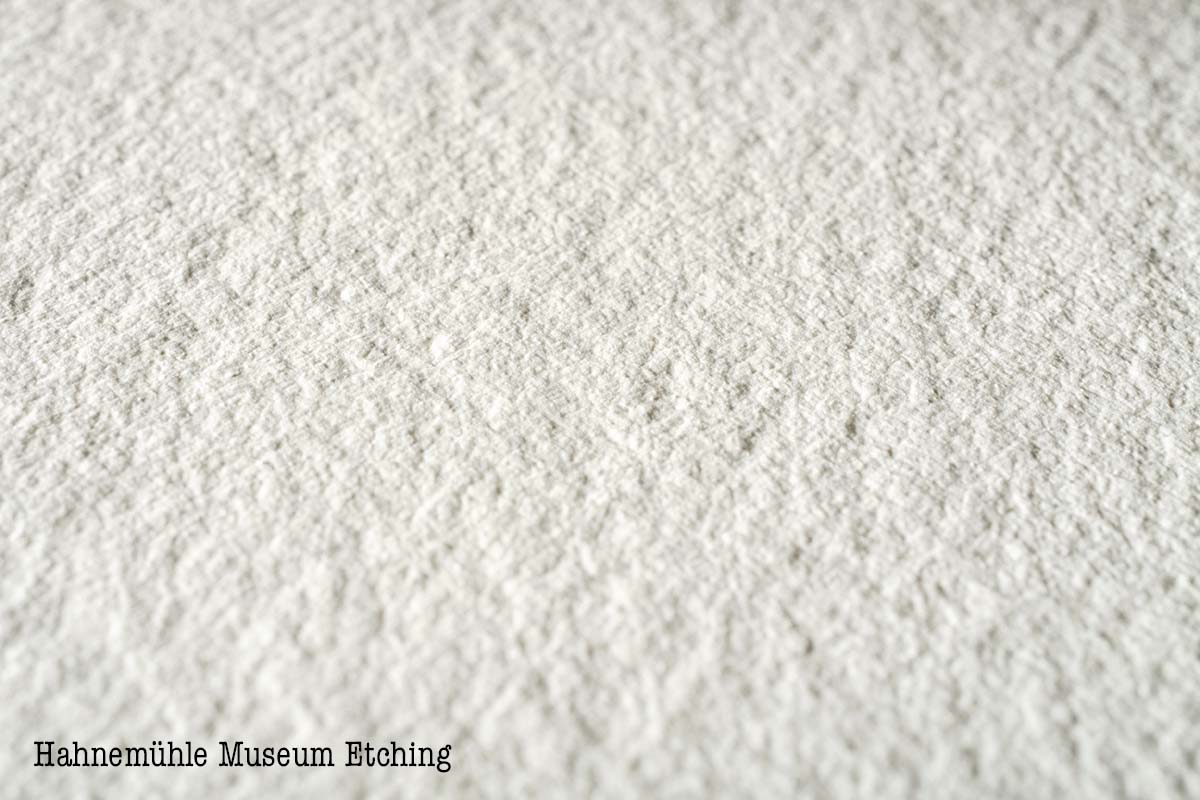

Museum Etching is similar to German Etching but not quite as edgy. If you print a fair amount of your output on this paper - and it is available in quite large sheets - you can invite girls up to see your etchings. I did, and it just shows you what my social life is like. They came up and wanted to see etchings...


There is no disguising the cloth pattern evident in the Monet Canvas sheets - it would be an ideal choice for the sort of art image that one wraps around wooden frames for wall display. Hahnemühle themselves make kits to allow this sort of thing to be done. The kits are very good value and if you can put good colourful images on them you can sell them for a good price. Then you'll be in the Monet...

Not every image suits a rough surface, and not every printer will handle these papers. You need one that can be set so that the paper moves in and out of it on a straight, flat line. You may need to bend or steam the papers to get them to obey. But the artistic effect on the right image is magical...and when you get the trick operating right you can produce print after print the same way.


* I cannot be fürtive about it. I like the ümlaut key. It's fün to üse... 


Labels: , , , , , , ,

Wednesday, January 18, 2017

The Paper Shuffle - Part Three - The Smooth German Connection

 
Hahnemühle are historic papermakers from Dassel in Lower Saxony. With a lot of small creeks ( " bachs " ) running through the place and forests nearby, it has proved to be a good location to make woodpulp and paper - they've apparently been doing it since 1584.

Currently there is a wide selection of papers that have been turned to the inkjet printing application from the company. Camera Electronic have had them for years and supplied some very special surfaces in large flat sheets. As well, there are rolls avaiable for the larger inkjet printers.

The Hahnemühle sample books have always been amazing things - exotic surfaces and extremely well-printed images that make you jealous. As well, they produuce a number of sampler packs to let people assess the things for themselves...but therein lies a problem. What are you supposed to be looking for and how will you know it when you see it?

Add to this the artistic question of what image suits which paper and you have a pretty wide field of speculation. I'll admit to buying a pack of Hahnemühle paper a few years ago based upon the name of it and a mistaken assessment of my own printing skills...and disappointing myself. But the story did have a happy ending - I eventually found which of my images would suit the surface and got the last 5 sheets of the packet to print perfectly.

Well, here's the smooth surfaces under the examining lens. Remember that these are all matt and will need the matt ink option - plus they will not quite get to the black of a gloss surface. But they are stylish and marvellously sturdy - a print on the 308 surface has a really impressive feel.


See the lay of the Rice Paper?


The 220gsm and less emphasised texture of this Photo Rag Book & Album means that you will be able to pack more pictures into the album and any text printeed with the image will be easy to read.


Bamboo. It is not necessarily a surface dedicated to Asian images...but the classic look of misty mountains and clouds would be well-suited to this broken surface. The disruption of it would probably suit rural images with natural shapes better than urban ones with man-made straight lines.


Ah, here we go for that technical image. The Photo Rag Ultra Smooth is 305 gsm but does not raise as many irregularities on the surface and would not disrupt fine detail.


The classic Hahnemühle fine art paper, Photo Rag 308 is often seen with the big roll printers. It supports some of the best landscape art in this state as well as commercial portraiture. See how it breaks the light just that little bit more than the Ultra Smooth?


Disregard what your screen or my camera shot might say - this is a noticeably whiter paper than the 308, as wll as picking up a little more weight; 310gsm.


I cannot say what this Daguerre Canvas looks like with an image because I have been told that my printer will not print canvas. I've been told a lot of things in the past few years but gone right ahead and done them anyway. I'll tel you what happens on a future post...

And that is the idea of these sample packs.They're A4 with two sheets of each surface in the parcel at a bargain price. You could do far worse than just getting a pack, going over your pictures for suitable art, and putting them through your printer. Hahnemühle have the profiles on-line, and they will be necessary, but that is easily done.


Labels: , , , , , , , ,

Friday, July 15, 2016

Sticking Together Through Thick And Thin - The Photo Glue Saga


One of the first important responsibilities we encountered as children in kindergarten was the glue pot.

No matter whether you found it in Europe, Britain, Canada, or Australia, it was the same thing - a big glass jar filled with something gelatinous and stoppered with a lid that never fit. Frequently there was a brush thrust through the lid. It was sticky on the inside and sticky on the inside and exuded an odour of strange chemistry.

We all tried to eat it at some stage of the game.  Wise schools invested in non-poisonous types...

As photographers we have also dabbled in glues - from the clear mucilages in bottles that we stuck pictures into albums with through various specialist formulae in tubes and then on to spray cans for bigger prints. Some stuck, some didn't - some ruined the photos and some left them untouched  - it really was a by-guess-and-by-gosh situation for amateur shooters.

Professionals had their hot presses and sheets of varnish tissue that they could use to mount large prints to matte boards. These were reliable if served with good materials and a degree of skill, but could ruin a print in 30 seconds if you got any grit trapped on the platen. Plus they were hot - and big - and expensive. And the materials to mount with them also cost a fair bit.

Which brings us to the subject of the post - the Hahnemuhle Archival glue in a 4 oz. bottle. The stuff is more than just a Bunnings bottle - it is pH neutral and will not come boiling out of the frame to wipe your work off the canvas or paper. Unfortunately you cannot say that about many other products - slather them on and watch in horror over the years as they let go and everything falls apart or start to turn all sorts of colours and shapes.

 As a model diorama builder I am keenly aware of the different reactions that glue and adhesives undergo when they are being used on different materials. I have watched careful work disappear under chemicals exuded by cyano-acrylates  years after assembly. The awful part about this is that the parts may be welded for eternity with the contamination locked inside the structure - short of sawing it apart you can't get in to clean up.

A side issue was the discovery of the effect of humidity and the expansion and contraction under  print display conditions.  This robbed one of my exhibitions of all dignity a few years ago as matted prints twisted themselves into Dorito shapes and fell off the frames that were displaying them. Subsequent years saw different glues and tapes tried , and in the end the best mounting turned out to be pinning unmounted prints to a hanging muslin backdrop.

Any rate, come into the shop and browse in the Hahnemuhle section. You'll find Gallerie Wrap canvas kits and frames as well as the 4 oz. glue and Hahnemuhle mounting spray. It's the spray glue of choice for a number of professional client and they go through a good deal of it.

Labels: , , , , , , , , , ,

Monday, June 6, 2016

When To Use A Pro Lab - 350 Reasons


The new digital photographer can be forgiven for being confused by any number of aspects of the sport - there seem to be so many to learn.

He or she used to be confronted only by which film to use, does the orange needle match the mark on the light meter, and is the Chemist open so that I can drop my film in? Then in two weeks it was should I buy another roll of film or a bag of barley sugar and box of bandaids?

Now it is white balances, tonal curves, video frame rates, colour spaces, and all the rest. No wonder they have started putting an " Automatic " setting on new cameras and dedicating a knob or lever to it. The relief for some shooters must be palpable.

It is nearly the same for the shooter who wants paper prints of their work. What do they do now that the chemist has gone out of photofinishing and reverted to selling overpriced vitamin supplements and something for the weekend? What are the alternatives with that card full of images?

a. Print it yourself at home on a multifunction printer from Officeworks. No, please - go ahead and do it. The printer will only cost you a hundred bucks and you'll be so disappointed with the results that you won't even have to buy expensive ink cartridges later to try again. The larger multifunctions make attractive pots for cactus.

b. Get Officeworks to print it for you on their big machine. This sometimes works to some extent if your file is perfect and your need is modest. Do not expect art. They are not going to correct your flaws. GIGO.

c. Get an Epson photo-quality printer and do it at home. This works. Start off with the Epson Surecolor SC-600 and move up to the SC-800 if you want larger prints and cheaper ink. Then cast your eyes at the even larger range of large format printers from the company. They will not be cheap but their quality of print is professional and you can be sure that the prints that emerge with K-3 ink on quality Epson, Ilford, Permajet, or Hahnemuhle paper will be be permanent and accurate.

But sad to relate, you are still going to have to be doing a good job with the files. You'll be telling the computer what you want, but you'll have to make sure your monitor is showing you the truth. ( Hint: Spyder colour calibrators, EIZO screens...) And you'll have to make sure that the computer tells the printer the right thing to do ( Hint: either, you, the computer, or the printer will have to manage the colour. Decide early.) And you'll have to make sure that the printer knows what paper you're using ( Hint: paper profiles.)

You will also need to ensure that you put the paper in the right side up. Do not ask this writer how he knows that. Take it for granted that he knows...

A little unsure about all the settings and alternatives? Then you need the Automatic solution...

d. Take the files on a hard drive, CD, or memory card to a professional photofinishing lab. They have not disappeared with the advent of digital - in fact the good ones are going strong because they are the good ones. And they are resourceful, technically skilled, and helpful.

A visit to a professional photofinisher like Fitzgerald Photo Labs at 350 Fitzgerald Street, North Perth
is almost as easy as it used to be to put your films into the chemist. There are real people there who can look at your files and advise you on the optimum sizes that they can be printed. They can suggest paper surfaces for larger works. They can frame the bigger prints - and there are so many options for modern display that you can never run out of a fresh decor idea.

They are able to handle film needs as well - lots of people still shoot on film - and converting the negatives and transparencies to digital files is easy these days. You can get your work back in dual form - digital as well as paper print.

Again you can be sure that the pictures you pay for will be permanent. The big labs use Epson K-3 ink on their big machines.

The joy of a big lab like Fitzie's is that the printing people are there to talk to you and they know what they are doing from long experience. It is not just machine minding in a large furniture or discount store for them. Their job is a profession and they produce professional quality - and that's why Camera Electronic depend on them for our advertising banners and promotional prints. These need to be right and they ARE right.

For those of you  point out that I have forgotten the discount store and the furniture shop...well I remember them when I need tee shirts or kitchen chairs. But not when I need good quality photofinishing.

Labels: , , , , , , , , , , , , , , , , , ,

Thursday, September 24, 2015

Fine Art Paper - Pulp Friction Brought To Life


I realise that using the phrase fine art photography is a dangerous thing - it seems to be two adjectives chasing a noun. And in many cases unsuccessfully...But at least we can try.

If you hope to present digital images that will be hung you must make sure they deserve to be*. This means a great deal of careful work before the printer whirrs - photographing, editing, critiquing. The printer that you choose and the inks that it will use are prime factors as well...but the chief thing that has to be right is the paper.

It has to last. People who pay money for pictures want those pictures to stay flat, stay clean, and stay the way they were when the money changed hands. Thus you need to search out archival-quality paper. "Archival Quality" is also a fraught phrase but at least there are some scientific standards for it - laboratories have established criteria for the longevity of paper and ink and published them. Various manufacturers tell us that their products meet these standards.

Of course, performance over a passage of time is only tested by the passage of that time. There might be a sales warranty issue on the Great Pyramid of Cheops over the stone facing that has fallen away...but the builders are nowhere to be found.

But back to your prints. Your surface needs to be appropriate to the image presented. Some people want canvas - some paper. Some want aluminium - they can all be accommodated these days. The papers can be smooth matt, smooth gloss, smooth semi-gloss, or can have texture imparted in the manufacture. Some are extremely rough, but if the image can be of blocky form this may be just perfect.

On a technical point - the heavy papers can be very heavy and you'll need to see if your printer can deal with the increased thickness. They may also have considerable warp and droop and you'll need to make provision to eliminate or cope with this as well. Crude as it sounds, you might find yourself doing a bit of judicious paper bending with your fingers before you press the start button.

You'll be confronted with some real choices in the base colour of the paper. Various words are bantered about; wheat, buff, cream, ivory, etc. but the end result is off-white. See if your image is one that will be complemented by this sort of thing or whether you'll need a clear white. these are available too.

Come in an browse amongst the Ilford, Hahnemuhle, and Permajet products. Some can be got in sheet form and some in roll. Sample packs are here so that you can experiment before lashing out for a full box.

* Either they hang or you do...


Labels: , , , , , , ,

Thursday, August 13, 2015

Lustre, Semigloss, and Smooth Pearl - The Paper Cuts


Okay, I can tell the difference between these if I look hard...but if the various manufacturers come out with new surfaces like Semi-Lustre, Semi-Semi-gloss, and To A Certain Extent  Smoothish Sort Of Pearl I am going to just take the box nearest the front and whack that into the printer. If I am feeling fussy I'll put it in the right way up and if not I'll just stand at the door and throw the box at the machine...

You can still get sample books for paper surfaces and colours from various makers and sometimes they are a help - however paper development can leapfrog past their own publicity and sometimes the books fall out of date. And sometimes the images in the books seduce us into believing that our own pictures will look as good, but then leave us standing.

This isn't a new phenomenon- the old darkroom paper books from Ilford, Agfa, Kodak, Ansco, Seagull, Gevaert, etc. were mostly black and white but could exhibit such a variety of effect for surface and colour as to fill any professional need. Some papers were bizarre - witness the silk pattern surfaces and some of the heavily swirled ones. There were artistic reasons for it, as there are for heavily textured inkjet papers, but these were few and far between. Mind you, we all tried them and as fate would have it, some of the best portraits of people we love are seen on these odd papers - if we have lost the negatives we are left with just the oddities.

Commercial considerations often dictate the surface for giant inkjet prints - in some cases canvas is the material of choice. Artists sometimes favour matte surfaces to suggest watercolour paper. Technical prints may benefit from a high gloss.

The default paper, though, probably is some sort of a slightly broken clear white. Ilford, Hahnemuhle, Harman, and Permajet all make something of this nature, and if you wish to print A2, A3+, A3, A4, 5 x 7, and 6 x 4 there are ready supplies in bulk.

Indeed - sometimes there are great bargains - once a year Ilford used to give from 5 to 10 free sheets of their standard papers in special packs at the regular price. Right now we have Harman A4 in 100 sheet boxes for under $ 50. If you've a printer and are a Printer, come visit.

Labels: , , , , , , ,

Friday, February 27, 2015

Epson 3000 Printer - Business Card Special


I have just changed the name of my little studio - the old registration was due for renewal and the government wanted money to let me enjoy myself. I decided to do so without their let or hindrance.

Pity about the pile of older business cards. No good now - I chucked them in the bin.

But what options for new ones? Fortunately in the Pages program that live in my iMac computer there is a selection of self-print business cards. One is termed a "Modern Photographer" ...with a small graphic design of a 4" x 5" sheet of film! You can take the icons off the shelf, but you can't take them out of the mind...

Okay -  added all the information about name, address, phone number, and blog site. I assigned photos of ten of my Hot Rod Honeys into the little 4 x 5 sheet film graphic.

Then I cast about for the thickest and stiffest printing paper in the computer room. Like anyone in the trade, I have a pile of cast-off equipment and supplies that serve to do most of the hard work of my hobby. In this case I dug out a half-used box of rough old Hahnemuhle paper - something that was intended to be used for fine art and high ideals. I have long realised that these two concepts have nothing to do with me, so the paper languished.

Well, it is nice paper. And it is thick. I've had thinner sandwiches on British Rail. It is far too thick to pass through the ordinary paper path on my Epson 3000.

Bless Epson, they are used to dealing with people as simple as I - You press the menu button on the printer and it gives a step-by-step breakdown on how to load thicker material utilising the front feed slot and a shallow curved holder at back. It's always worthwhile physically bending the paper flat before you load it - just prevents head strike or ink smear.

Anyhoo - you have to instruct the printer what paper it is, and if you don't have the Hahnemuhle profile loaded you can make do with the Epson Matte or Archival Matte and it prints pretty well. Once you do, it fires out a pretty good A4 with ten of he business cards on it - and the best part is that at the margins of the paper it prints cutting marks  -join them up with a pencil and scissors the cards apart.

Cheap? Well, the paper was just sitting there...Nasty? Not a bit. Thick, but...like a British Rail sandwich.

Labels: , , , , ,

Thursday, November 27, 2014

Spray And Pray With Hahnehuhle


Those of you who print out your images on inkjet paper for inclusion in physical albums are probably acutely aware of the need to select those albums with care. We all remember the toxic photo albums of the 70's and 80's that engulfed and digested our postcard colour prints. Sticky pages...if they were not sticky then, they are sticky now...the kind of precious family memories that you like to look through on a quiet Sunday when you are dressed in a HAZMAT suit. Talk about bombing out!

Well, before you fly to the closet and drag them out with iron hooks, consider that your current album may be better, but you are still subject to whatever he paper is going to do to the paper. And if you print large-size images for wall mounting you are exposing the surface of the inked paper to all the atmosphere can send - acids, smokes, cooking oils emulsified in the air, etc. Those prints need protection.

Well for years we have been selling cans of spray protection to very prestigious fine art printers here in Perth. They select the Hahnemuhle Protective Spray in standard cans. We don't keep the cans locked up because you can't really graffiti anything with them...

The spray will make an inkjet print highly water resistant, scratch resistant, and greatly enhance the UV resistance.

In stock all the time. Start spraying.


Labels: , , , , ,

Tuesday, October 7, 2014

New Paper Packaging For Hahnemuhle


I was quite taken with the new packaging for Hahnemuhle papers - here you can see the really really big size for really really big images...

Unfortunately there are no inkjet printers big enough to take this size here in the shop just now, but we do have similar-looking A4 and A3+ packages. And we have A3+ and A2 printers and plenty of ink.

Hahnemuhle is premium quality fine art paper in a number of professional finishes. With the correct profile and colour management it makes ravishing prints.

Labels: , , , , ,

Friday, July 11, 2014

Ze Return Of Ze German A4


Ve haf had a happy experience vis ze Hahnemüle inkjet papers in ze past und now ve haf zem return in ze A 4 size.

You vill observe zat there are these in our shop:

Photo Rag                            A4 310 gsm
Photo Rag Bright White  A4 310 gsm
German Etching                 A4 310 gsm
Photo Rag Satin                 A4 310 gsm

Zey are good papers and vill make all inkjet prints look well. Of course, you vill need to download ze profiles from zere vebsite for zis.

Ze time has come to rejoice and print. If you vish to rejoice larger zey are also in bigger sizes.

Labels: , , ,

--> Camera Electronic

Camera Electronic