Thursday, January 26, 2017

The Giant Economy Size


We sell lots of things in Camera Electronic that are intended to be small; Olympus cameras, Gitzo traveller's tripods, Metz LED lights. But we also sometimes lash out and get the Giant Economy Size. Case in point: The Premier Eco Print Shield cans.

These are a liquid coating for your inkjet paper and canvas prints that will stop the UV rays from messing with the colours - they also stop airborne pollutants and moisture from ruining the surface of the print. This may not seem important if all your pictures are on your iPhone or 6 x 4 postcards in a shoe box...but the big boys and girls who print out on large format printers and frame their exhibition work know different.

Now the statement that something stops UV damage completely is a difficult one to make - particularly in Western Australia where we manufacture ultraviolet radiation for export. You have only to listen to the weather reports every day to realise that our WA UV index scale starts at " Extreme " and goes up from there. About the only complete UV protection for anything is to put it inside the turret of a Sherman tank and close the hatch...

But the Premier Eco Print Shield does help. It can make the difference for an interior display between a year's safety and 5 years. If you are selling your work, that is important...it gives you time to get away.

Two finishes in stock - Matte and Satin, and you can spread it with bush, roller, or spray gun. If you choose the last mode of delivery you will need a gun with a wide throat to get this solution out...and make sure that you clear and clean your gun between applications. This is thick stuff.

If your needs are more modest, there is also the Hahnemühle spray in aerosol cans - some pros rely on this exclusively.

Note to those people whose entire portfolio is on their iPhones, iPads, or the 8-year old computer that seems to be a little slower at booting up these days...Start to print out some of your best work. The thrill of seeing it in the hand and on the wall is reward enough for your trouble. And people will think of your output in more concrete terms when it is hanging off the concrete.

Plus...for those with the entire portfolio on the Fisher-Price My First Hard Drive...remember the old Bond's underwear ad slogan..." One day, you're gonna get caught..".


Labels: , , , , , , , , , , ,

Thursday, January 19, 2017

The Paper Shuffle - Part Four - Rough Justice

 
Life is not all smooth and sleek in Dassel, Lower Saxony, and neither is it in the Hahnemühle factory. At least not in the division that makes the Matt Fine Art - Textured inkjet paper.

I don't know if the firm chops down chunkier trees or employs rougher workmen, but the results have a rugged charm all their own. Prepare to pick your way through a plowed field of paper. Mind your ankles.


Holy Moley, Batman...that is one rough surface. A definite lay and pattern to the Albrecht Dürer and enough texture to break any image into a pastel drawing effect.


Okay, if Dürer was a German artist who made etchings düring* the Renaissance, who was Torchon? And why did he draw on something that looks like the side of a barn? Turns out a torchon is a French tea-towel, which explains this surface perfectly. Is it too silly to suggest that you should print pictures of French food on this paper?


German Etching suggests monochrome images with sharp delineation and serious subjects. My experience with it was tempered by bad language and the realization that paper has a mind of its own - a mind that can be changed by heat and humidity. It can also be bent into shape to counteract these tendencies.


William Turner was a Romanticist landscape painter and I am wondering if the naming of this paper may unconsciously lead to photographers utilizing it for images that feature rain, steam, and speed. Will they be committing images to preset plug-ins with brush strokes. Will they turn the Gaussian blur up to 139? Of course we will...


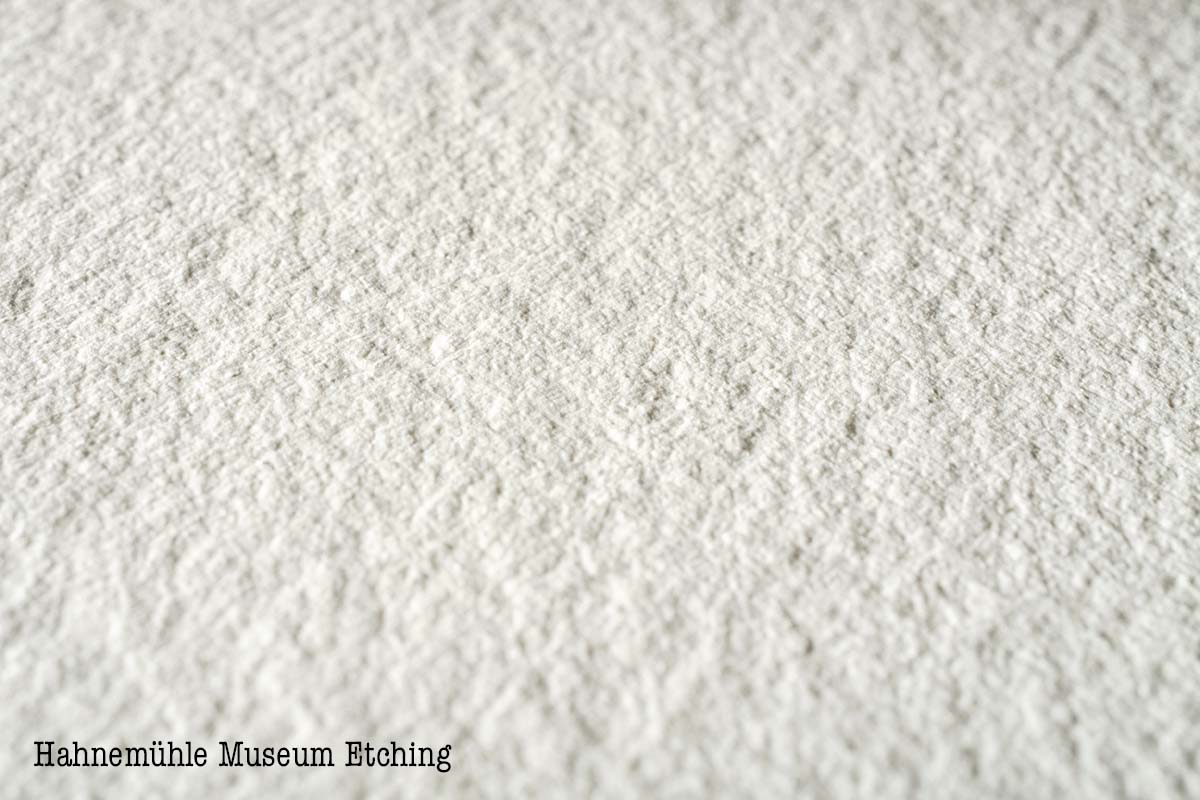
Museum Etching is similar to German Etching but not quite as edgy. If you print a fair amount of your output on this paper - and it is available in quite large sheets - you can invite girls up to see your etchings. I did, and it just shows you what my social life is like. They came up and wanted to see etchings...


There is no disguising the cloth pattern evident in the Monet Canvas sheets - it would be an ideal choice for the sort of art image that one wraps around wooden frames for wall display. Hahnemühle themselves make kits to allow this sort of thing to be done. The kits are very good value and if you can put good colourful images on them you can sell them for a good price. Then you'll be in the Monet...

Not every image suits a rough surface, and not every printer will handle these papers. You need one that can be set so that the paper moves in and out of it on a straight, flat line. You may need to bend or steam the papers to get them to obey. But the artistic effect on the right image is magical...and when you get the trick operating right you can produce print after print the same way.


* I cannot be fürtive about it. I like the ümlaut key. It's fün to üse... 


Labels: , , , , , , ,

Wednesday, January 18, 2017

The Paper Shuffle - Part Three - The Smooth German Connection

 
Hahnemühle are historic papermakers from Dassel in Lower Saxony. With a lot of small creeks ( " bachs " ) running through the place and forests nearby, it has proved to be a good location to make woodpulp and paper - they've apparently been doing it since 1584.

Currently there is a wide selection of papers that have been turned to the inkjet printing application from the company. Camera Electronic have had them for years and supplied some very special surfaces in large flat sheets. As well, there are rolls avaiable for the larger inkjet printers.

The Hahnemühle sample books have always been amazing things - exotic surfaces and extremely well-printed images that make you jealous. As well, they produuce a number of sampler packs to let people assess the things for themselves...but therein lies a problem. What are you supposed to be looking for and how will you know it when you see it?

Add to this the artistic question of what image suits which paper and you have a pretty wide field of speculation. I'll admit to buying a pack of Hahnemühle paper a few years ago based upon the name of it and a mistaken assessment of my own printing skills...and disappointing myself. But the story did have a happy ending - I eventually found which of my images would suit the surface and got the last 5 sheets of the packet to print perfectly.

Well, here's the smooth surfaces under the examining lens. Remember that these are all matt and will need the matt ink option - plus they will not quite get to the black of a gloss surface. But they are stylish and marvellously sturdy - a print on the 308 surface has a really impressive feel.


See the lay of the Rice Paper?


The 220gsm and less emphasised texture of this Photo Rag Book & Album means that you will be able to pack more pictures into the album and any text printeed with the image will be easy to read.


Bamboo. It is not necessarily a surface dedicated to Asian images...but the classic look of misty mountains and clouds would be well-suited to this broken surface. The disruption of it would probably suit rural images with natural shapes better than urban ones with man-made straight lines.


Ah, here we go for that technical image. The Photo Rag Ultra Smooth is 305 gsm but does not raise as many irregularities on the surface and would not disrupt fine detail.


The classic Hahnemühle fine art paper, Photo Rag 308 is often seen with the big roll printers. It supports some of the best landscape art in this state as well as commercial portraiture. See how it breaks the light just that little bit more than the Ultra Smooth?


Disregard what your screen or my camera shot might say - this is a noticeably whiter paper than the 308, as wll as picking up a little more weight; 310gsm.


I cannot say what this Daguerre Canvas looks like with an image because I have been told that my printer will not print canvas. I've been told a lot of things in the past few years but gone right ahead and done them anyway. I'll tel you what happens on a future post...

And that is the idea of these sample packs.They're A4 with two sheets of each surface in the parcel at a bargain price. You could do far worse than just getting a pack, going over your pictures for suitable art, and putting them through your printer. Hahnemühle have the profiles on-line, and they will be necessary, but that is easily done.


Labels: , , , , , , , ,

Thursday, October 6, 2016

The New Bike On The Block - the X-T2


The new Fujifilm X-T2 is dazzling the mirrorless crowd right now, but the last two weblog columns showing the results of a studio shoot may have given the impression that it is no better than previous models. Here's where I reveal the truth - I was only looking at a small part of the picture before. There was some wiggle room there in the writing.

You remember I showed little 1200 x 960 pixel images and they all looked about the same. Well have a look what happens when I go back to the main image and zero in on the motorcycle headlights.


Yep. The extra division of the X-T2 sensor makes more pixels available for enlargement and the image is much, much smoother. So the advice here is to get the newer camera if you intend to blow your images up past A4 or if you need to extract small portions of them.

You will also get the option of an additional film simulation setting over and above what the X-E2 or X-T1 can provide and even more compared to the X-Pro1 or the X-100. If one of them is your preferred look, you need look no further.

The computer experts will argue that there are any number of film simulations available as extra plug-ins for image editing programs - and so there are. But how much neater to have them applied as the image rolls out of the camera - in many, many cases the JPEGs that come out of the Fujifilm X-Trans sensors can be used for reproduction straight away without further managing...as a number of weblog columns and newspaper advertisements will attest. No, I won't tell you how easy it is to do, in case it affects my pay...

The lens in use on the X-T2 today was a Tokina macro 35mm f:3.5 and was totally manual in operation. Had it been an AF lens I would have steered the AF single point marker to the exact centre of the headlights using the little rubber joystick under the right thumb. It is a vast improvement on the menu wheel as a selector. You are less inclined to twist the camera about trying to get the green square on the subject...or worse, to just blaze away hoping that whatever is in focus when it beeps and fires is really what you wanted. Far better to actually command your vision rather than be commanded.

What a didn't turn on in the studio was the wide field of focus points that this camera is capable of using - the field shooter may well opt for this as the best way of operating the AF. I also did not need to instruct the camera about predictive tracking and the persistence that I might want with the AF in case something intervenes between me and the subject. It's all there in the menu.

Perhaps it is time to take a couple of the cameras out to see some real automotive action and give these features a test as well...Stay tuned.

See the full Fujifilm range at Camera Electronic here

Labels: , , , , , , , , ,

--> Camera Electronic

Camera Electronic