Tuesday, February 14, 2017

Quite Possibly The Leica For You


Leica cameras are not for everyone.

This is not just because of their price  - which is considerable. It is also because they may not be the exact tool for the job that you intend to do. If you are hanging out the side of a helicopter taking survey pictures of a forest you might be using a Hasselblad. If you are photographing polar bears in Churchill, Manitoba you may not want to do it with a wideangle lens from two metres...If you are doing technical architectural illustration you may want swings, tilts, shifts, a Bex, and a good lie down...

But.

 If you want the ultimate travel/tourist/photojournalist/street/life camera the Leica company very likely has the best one that you will ever own somewhere in its range. For the person who wants to do it all pretty close by and on one package, the Leica Q is really the answer.

It contains one lens, one sensor, one screen, and one viewfinder - which is not that unusual for digital cameras. Unlike some of the other Leica offerings, however, the lens on the Q does not come off. It also does not zoom in the conventional way...but nevertheless contains three focal lengths. and it is a macro lens.

Your own vision of what you want to take pictures of resides in your head - but on the Leica Q it is shared between the LCD screen on the back and the electronic viewfinder. No tilting screen - the whole thing is rock solid.

The lens looks at the world with the angle of view of a 28mm focal length all the time, but the viewfinder image is changed by a ring around the lens to show an internal cropping for either a 28mm, 35mm, or 50mm field of view. You can rest assured that the Leica lens and processor will deliver the resolution, contrast, and freedom from distortion that you expect at all those settings.

You also get a detented switch that will let the camera lens go down to an extremely close macro setting. So you are carrying four things in one - and you are carrying a closed system that will never need the repeated attention of a camera technician for screen cleaning and dust removal. You just go out there and shoot.

Now look at the heading image again ( Thank you to the Leica Club visitor who acted as an unwitting hand model. ). The controls are disposed on the camera exactly where you expect them to be. Aperture ring up the front - and you can take it off the click-detent automatic position through the manual aperture from f:1.7 to f:22. Shutter speed Automatic and then 1 - 1/2000 second. Manual or automatic focus - you choice.

That titanium finish is unique - you can also get it black. Plus a number of imaginative cases.
If you ever wanted to own one Leica - just one - and did not want to take extra lenses or accessories with you, this is the one. And I'll contradict myelf instantly by recommending that you also invest in a Leica flash as well...but that is because I am a flash shooter and know how useful the things are -  purists can disagree.

Labels: , , , ,

Thursday, January 26, 2017

The Giant Economy Size


We sell lots of things in Camera Electronic that are intended to be small; Olympus cameras, Gitzo traveller's tripods, Metz LED lights. But we also sometimes lash out and get the Giant Economy Size. Case in point: The Premier Eco Print Shield cans.

These are a liquid coating for your inkjet paper and canvas prints that will stop the UV rays from messing with the colours - they also stop airborne pollutants and moisture from ruining the surface of the print. This may not seem important if all your pictures are on your iPhone or 6 x 4 postcards in a shoe box...but the big boys and girls who print out on large format printers and frame their exhibition work know different.

Now the statement that something stops UV damage completely is a difficult one to make - particularly in Western Australia where we manufacture ultraviolet radiation for export. You have only to listen to the weather reports every day to realise that our WA UV index scale starts at " Extreme " and goes up from there. About the only complete UV protection for anything is to put it inside the turret of a Sherman tank and close the hatch...

But the Premier Eco Print Shield does help. It can make the difference for an interior display between a year's safety and 5 years. If you are selling your work, that is important...it gives you time to get away.

Two finishes in stock - Matte and Satin, and you can spread it with bush, roller, or spray gun. If you choose the last mode of delivery you will need a gun with a wide throat to get this solution out...and make sure that you clear and clean your gun between applications. This is thick stuff.

If your needs are more modest, there is also the Hahnemühle spray in aerosol cans - some pros rely on this exclusively.

Note to those people whose entire portfolio is on their iPhones, iPads, or the 8-year old computer that seems to be a little slower at booting up these days...Start to print out some of your best work. The thrill of seeing it in the hand and on the wall is reward enough for your trouble. And people will think of your output in more concrete terms when it is hanging off the concrete.

Plus...for those with the entire portfolio on the Fisher-Price My First Hard Drive...remember the old Bond's underwear ad slogan..." One day, you're gonna get caught..".


Labels: , , , , , , , , , , ,

Thursday, January 19, 2017

The Paper Shuffle - Part Four - Rough Justice

 
Life is not all smooth and sleek in Dassel, Lower Saxony, and neither is it in the Hahnemühle factory. At least not in the division that makes the Matt Fine Art - Textured inkjet paper.

I don't know if the firm chops down chunkier trees or employs rougher workmen, but the results have a rugged charm all their own. Prepare to pick your way through a plowed field of paper. Mind your ankles.


Holy Moley, Batman...that is one rough surface. A definite lay and pattern to the Albrecht Dürer and enough texture to break any image into a pastel drawing effect.


Okay, if Dürer was a German artist who made etchings düring* the Renaissance, who was Torchon? And why did he draw on something that looks like the side of a barn? Turns out a torchon is a French tea-towel, which explains this surface perfectly. Is it too silly to suggest that you should print pictures of French food on this paper?


German Etching suggests monochrome images with sharp delineation and serious subjects. My experience with it was tempered by bad language and the realization that paper has a mind of its own - a mind that can be changed by heat and humidity. It can also be bent into shape to counteract these tendencies.


William Turner was a Romanticist landscape painter and I am wondering if the naming of this paper may unconsciously lead to photographers utilizing it for images that feature rain, steam, and speed. Will they be committing images to preset plug-ins with brush strokes. Will they turn the Gaussian blur up to 139? Of course we will...


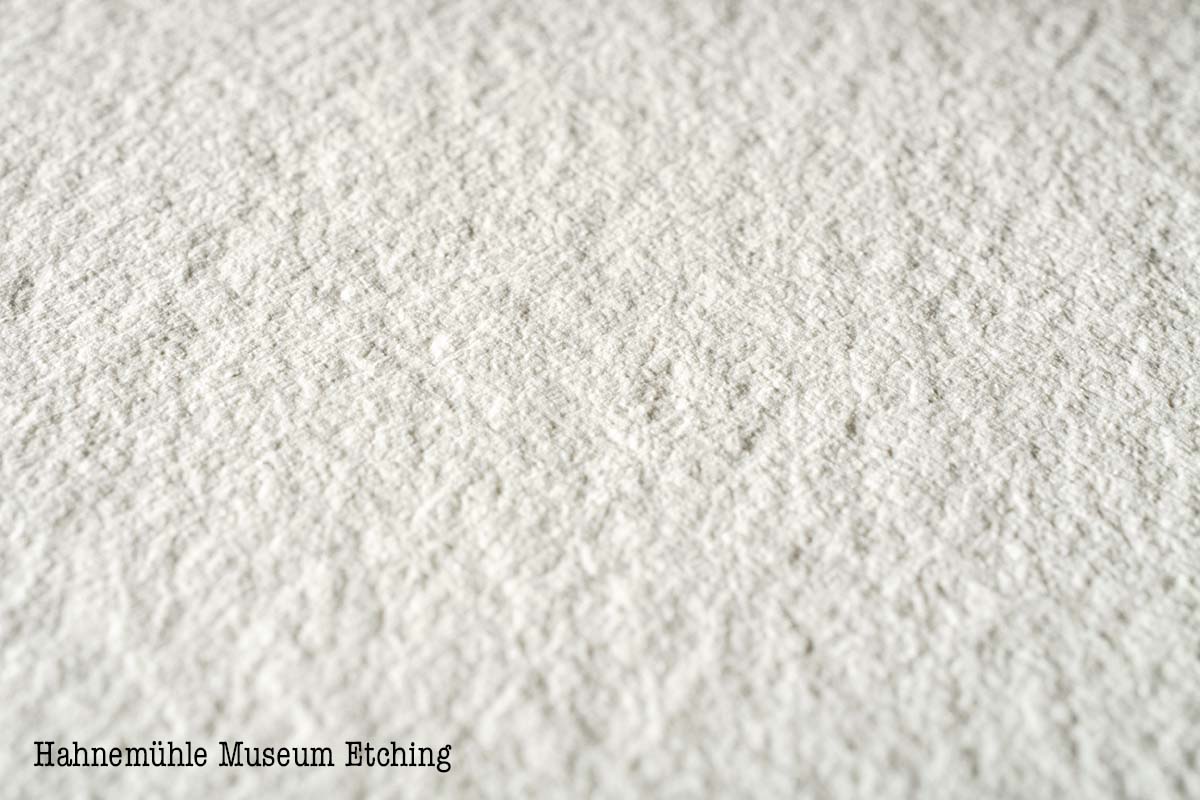
Museum Etching is similar to German Etching but not quite as edgy. If you print a fair amount of your output on this paper - and it is available in quite large sheets - you can invite girls up to see your etchings. I did, and it just shows you what my social life is like. They came up and wanted to see etchings...


There is no disguising the cloth pattern evident in the Monet Canvas sheets - it would be an ideal choice for the sort of art image that one wraps around wooden frames for wall display. Hahnemühle themselves make kits to allow this sort of thing to be done. The kits are very good value and if you can put good colourful images on them you can sell them for a good price. Then you'll be in the Monet...

Not every image suits a rough surface, and not every printer will handle these papers. You need one that can be set so that the paper moves in and out of it on a straight, flat line. You may need to bend or steam the papers to get them to obey. But the artistic effect on the right image is magical...and when you get the trick operating right you can produce print after print the same way.


* I cannot be fürtive about it. I like the ümlaut key. It's fün to üse... 


Labels: , , , , , , ,

Wednesday, January 18, 2017

The Paper Shuffle - Part Three - The Smooth German Connection

 
Hahnemühle are historic papermakers from Dassel in Lower Saxony. With a lot of small creeks ( " bachs " ) running through the place and forests nearby, it has proved to be a good location to make woodpulp and paper - they've apparently been doing it since 1584.

Currently there is a wide selection of papers that have been turned to the inkjet printing application from the company. Camera Electronic have had them for years and supplied some very special surfaces in large flat sheets. As well, there are rolls avaiable for the larger inkjet printers.

The Hahnemühle sample books have always been amazing things - exotic surfaces and extremely well-printed images that make you jealous. As well, they produuce a number of sampler packs to let people assess the things for themselves...but therein lies a problem. What are you supposed to be looking for and how will you know it when you see it?

Add to this the artistic question of what image suits which paper and you have a pretty wide field of speculation. I'll admit to buying a pack of Hahnemühle paper a few years ago based upon the name of it and a mistaken assessment of my own printing skills...and disappointing myself. But the story did have a happy ending - I eventually found which of my images would suit the surface and got the last 5 sheets of the packet to print perfectly.

Well, here's the smooth surfaces under the examining lens. Remember that these are all matt and will need the matt ink option - plus they will not quite get to the black of a gloss surface. But they are stylish and marvellously sturdy - a print on the 308 surface has a really impressive feel.


See the lay of the Rice Paper?


The 220gsm and less emphasised texture of this Photo Rag Book & Album means that you will be able to pack more pictures into the album and any text printeed with the image will be easy to read.


Bamboo. It is not necessarily a surface dedicated to Asian images...but the classic look of misty mountains and clouds would be well-suited to this broken surface. The disruption of it would probably suit rural images with natural shapes better than urban ones with man-made straight lines.


Ah, here we go for that technical image. The Photo Rag Ultra Smooth is 305 gsm but does not raise as many irregularities on the surface and would not disrupt fine detail.


The classic Hahnemühle fine art paper, Photo Rag 308 is often seen with the big roll printers. It supports some of the best landscape art in this state as well as commercial portraiture. See how it breaks the light just that little bit more than the Ultra Smooth?


Disregard what your screen or my camera shot might say - this is a noticeably whiter paper than the 308, as wll as picking up a little more weight; 310gsm.


I cannot say what this Daguerre Canvas looks like with an image because I have been told that my printer will not print canvas. I've been told a lot of things in the past few years but gone right ahead and done them anyway. I'll tel you what happens on a future post...

And that is the idea of these sample packs.They're A4 with two sheets of each surface in the parcel at a bargain price. You could do far worse than just getting a pack, going over your pictures for suitable art, and putting them through your printer. Hahnemühle have the profiles on-line, and they will be necessary, but that is easily done.


Labels: , , , , , , , ,

Monday, August 15, 2016

Brush, Palette, Mouse....Ready For the Louvre


Last year I was black-balled from entry into a Facebook group of artists - condemned for being an "events photographer". I suspect it was also because I was unable to speak Artish and would not get a tattoo or a man-bun.

Whatever, it set me out on a quest to become an artist in spite of the critics. I thought long and hard about what art I would pursue. Making miniature scenes was all very well, and taking pictures of weddings and hot rods and pretty girls might be a good training ground, but something more was needed. Something that would say Art loud enough and in a condescending enough manner to allow me to sit in a coffee shop and fill out Centrelink forms...What to do...What to do...

Then I had it. Digital art. Prints derived from images that I have taken, suitably modified until either they resemble other media or I resemble other artists.

Armed with that determination I ordered this book:


Focal press books are generally good, though they have had some authors who seem to have spent too much time in coffee shops filling out Centrelink forms. But in this case, Susan Roddick Bloom seems to have hit upon just the right level of communication to help the novice. And fortunately , Camera Electronic equipped me with the rest of what I needed.

Of course, I needed the images in the first place, and I've a Drobo full of them. And a Wacom Intuous tablet - CE had those too -  and a new iMac computer. I also had the Epson printer I got from CE and it is calibrated with the Spyder Express, so I was nearly all set. Final piece in the chain was the image editing program...and I went with my faithful Photoshop Elements 14.

It proved to be a good choice. Ruddick's book is several years old, but the basic procedures that she outlined in Photoshop itself are now quite do-able in the latest Photoshop Elements. There have been no procedures or techniques mentioned in her text that cannot be done in PE, and very few of the references she makes to specific things need to be translated to another wordage. Adobe have been decent enough to keep the same things in the same drawers in the digital desk.


Ms. Bloom covers sketches, pastels, cont, oils, watercolours, and illustrations. She has a chapter on some of the commercial plug-ins that also simulate drawn art...and she is not too prissy to admit that they can be a good jumping-off point for fast starts. I've tried a little from many of the chapters and found her advice to be excellent. it was money well spent.


The Photoshop Elements 14 program was also money well spent - and if you are at all interested in getting into digital shooting and manipulation I can recommend it.


Now it will be a case of experiment, practise, and time. One day I hope to be refused entry into ever more prestigious art groups. If I can be ejected from the Hermitage, Tate, or MOMA I shall consider myself a success.

Uncle Dick


Labels: , , , , , , , , , , , ,

Thursday, September 24, 2015

Good Colour Bad Colour Ugly Colour


The days of putting our films in to the chemist and hoping for some decent prints in a fortnight are long past. We now put our memory cards into the card reader and hope for some decent images in 5 seconds. The time occupied by gnawing anticipation is reduced greatly but we have also lost the consolation of being able to buy a bag of barley sugar sweets even if everything is blurry.

Same with colour. We once got what we were given and liked it. Sometimes we got what we deserved. The cost of colour slide film or colour printing in the film era was considerable - and we did not waste our shots. But what came back was tied to the temperature and purity of the baths in the processor and that could be a mixed bag - and sometimes the technicians loading the machines got it horribly wrong. Ask me about the wedding that vanished...

Nowadays we can get our colour RAW and cook it for ourselves. We can take precautions to prevent all but the direst disaster. Most of our weddings and some of our brides survive. Of course we may be wrong with the colour - that is still a subjective matter for most shoots. We are aided by the mechanisms in modern cameras and can make use of Datacolor colour charts of various types. We can calibrate our monitors and printers and viewing lights and everything. We can desaturate everything and talk up the art of it...fancy footwork can save a bad situation. Try to show the prints in a dark restaurant after a few drinks...

In the end, we need to remember that we are not making real objects - we are making flat images of real objects. We can get 66% of the way to realism but that third dimension kills it. If we are not making a stab at realistic representation we can even throw the 66% away - as long as we can please the viewer.

 Remember that sometimes we can't  - Vincent van Gogh made a dynamite starry, starry night but nobody wanted to buy it then.

Labels: , , , , , ,

Fine Art Paper - Pulp Friction Brought To Life


I realise that using the phrase fine art photography is a dangerous thing - it seems to be two adjectives chasing a noun. And in many cases unsuccessfully...But at least we can try.

If you hope to present digital images that will be hung you must make sure they deserve to be*. This means a great deal of careful work before the printer whirrs - photographing, editing, critiquing. The printer that you choose and the inks that it will use are prime factors as well...but the chief thing that has to be right is the paper.

It has to last. People who pay money for pictures want those pictures to stay flat, stay clean, and stay the way they were when the money changed hands. Thus you need to search out archival-quality paper. "Archival Quality" is also a fraught phrase but at least there are some scientific standards for it - laboratories have established criteria for the longevity of paper and ink and published them. Various manufacturers tell us that their products meet these standards.

Of course, performance over a passage of time is only tested by the passage of that time. There might be a sales warranty issue on the Great Pyramid of Cheops over the stone facing that has fallen away...but the builders are nowhere to be found.

But back to your prints. Your surface needs to be appropriate to the image presented. Some people want canvas - some paper. Some want aluminium - they can all be accommodated these days. The papers can be smooth matt, smooth gloss, smooth semi-gloss, or can have texture imparted in the manufacture. Some are extremely rough, but if the image can be of blocky form this may be just perfect.

On a technical point - the heavy papers can be very heavy and you'll need to see if your printer can deal with the increased thickness. They may also have considerable warp and droop and you'll need to make provision to eliminate or cope with this as well. Crude as it sounds, you might find yourself doing a bit of judicious paper bending with your fingers before you press the start button.

You'll be confronted with some real choices in the base colour of the paper. Various words are bantered about; wheat, buff, cream, ivory, etc. but the end result is off-white. See if your image is one that will be complemented by this sort of thing or whether you'll need a clear white. these are available too.

Come in an browse amongst the Ilford, Hahnemuhle, and Permajet products. Some can be got in sheet form and some in roll. Sample packs are here so that you can experiment before lashing out for a full box.

* Either they hang or you do...


Labels: , , , , , , ,

Friday, September 4, 2015

Save Everything - Whales, The World, Old Soap Wrappers, Jpeg's


Everything.

Save it on your computer drive, back it up to your Time Machine hard drive, then back this up to your Drobo, then burn CD's of the files, then print them out on an Epson printer, then rephotograph the prints with a 35mm copy camera and archivally process the film. Then store it in acid-free sleeves in a fireproof contaner.

Then take the discs and the film and the prints and any spare pixels that have fallen out of the back of the machine and put them in a safe deposit box down at the Bank of New South Wales.

You may want to ask the bank to sandbag the St. George's Terrace entrance and post guards armed with Stirling SMG's there - better safe than sorry.

After you have done this, go back and look at the images you started with. Are they really all that good? Is your student portfolio of 365 daily images of a banana on a plate really the stuff of your dreams? Have you advanced? Would it be a good idea to keep one picture of the banana and clean the rest out of the drive?

Just this thought occurred to me some time ago when I noted that the content level indicator on the Drobo drive I use got past half-full. Now the Drobo is a wonderful device for keeping things safe, as long as you keep it safe. I can re-disc it to far more capacity than it bears now...I'll do that eventually, but decided to look into the thing at present to discover what was in there.

Well, I didn't find the missing sock but I did find damn near everything else that I had dumped into it. Including jobs that had a set of RAW files, jpeg finder files, working psd files, and finished jpeg output files. Plus a few tiff's and something that looks suspiciously like a tram ticket. It was like an overgrown garden of pixels.

I set aside my ruth and weeded relentlessly - gaining back valuable disc space and concentrating each division into work that I am happy with. I did allow some wiggle room with RAW files that I may re-work...but even there I have been realistic with what was actually worth re-working. Let's face it folks, we usually get better as we go along, and it is retrograde to go back and try to make silk purses out of our sow's ears. They are never good and it annoys the sows.

Spring cleaning is not just for the carpet - try it and see.

Labels: , , , , , , , , , , , ,

Tuesday, April 14, 2015

Talk Arty To Me....In Mount Lawley


If you need to know, they want you to listen...

There is to be a talk tonight in the series " Talks For Emerging Artists " at the Astor theatre, Mount Lawley. Three presentations on the subject and some pretty good speakers.

The time is to be 7:00 and the entry fee is on a what-you-feel-you-can-pay basis. So this is a chance to measure your soul as well as your pocket.

Go to this link for more information:

https://www.facebook.com/events/745448755571347/

Good luck. Those of us who have been rejected as artists and have had to make do with being event photographers salute you...

Labels: , , , ,

Friday, December 12, 2014

World Record Paid For Photograph


DP Review has just reported that a fine art photograph produced by Peter Lik has been sold to an undisclosed private buyer for $ 6,500,000.

This gives us all hope that we may, with the proper equipment and opportunity, emulate this success. Unfortunately the report does not state which camera and lens was used, nor the aperture or shutter speed. Apparently the original file is a colour one and has been converted to monochrome for this sale.

The photograph was taken in Arizona in a place called Antelope Canyon. It shows sunlight filtering down through what may be dust or smoke. Or it could be from some form of vapour rising from the sand floor of the canyon. Unfortunately the highlight that shows the floor of sand is so bright that it obscures whatever is lying there - hard to tell what might be releasing the vapour.

Perhaps there had been a recent visit from antelopes. Or zebras.

Labels: , , , ,

Tuesday, June 25, 2013

Reverse Engineering In The Studio


We all know how reverse engineering goes in the commercial world - A Chinese company rep sends a new European product to his factory, they take it apart and make computer plans, then turn on the CAD-CAM machines and churn out low-priced copies. 

Their advertising office adds a vaguely-European name to it and then floods everyone's emails with promotion. This accounts for the Montgomery-Fitzhugh ffitch-ffitch Smythe tripod range from Guangzhao. It's a long way from Harrow to Herro...

It also works in the military field - wayward B-29s are interned by the Russians and Heigh-Ho here come 847 Tupolev 4 bombers. 

Well, a conversation yesterday with an artist alerted me to the fact that we sometimes have to do a little reverse engineer thinking in our camera shop. You see the artist wanted to take photographs that would serve as guides for her own paintings - portraits - and then wanted images to be available for further commercial reproduction. Once she had finished a canvas, she wanted a camera and lens combination that would be able to photograph the artwork for full-size reproduction.

So here's the reverse - I could have said a small-frame Nikon or Canon DSLR for the initial shots, but that would leave it wanting for the art copy. I could have said a moderate telephoto for the portraits, but that wold have made the art copy difficult - these are going to be large canvases. Zoom lenses and art reproduction are problematical due to distortion. Compromise, compromise.

In the end the best balance seems to be a Nikon D600 with a 50mm f:1.4 G lens or a Canon 6D with a 50mm f:1.4 EF lens. There will be more discussions about the business of lighting for portraits and flat artwork, but funnily enough some of the simple Elinchrom D-lite and RX sets are perfect for both applications.

It is good when a project like this can be looked at in detail right form the start - potential difficulties can be avoided - and it is also fascinating to think how many ventures would benefit from being seen and engineered in reverse.

Labels: , , , , , ,

Friday, March 1, 2013

Fine Art - Coarse Art - A Modest Proposal


It is a great privilege to work in the photographic trade in a capacity that brings me into regular contact with artists. Every day I learn something new from reading or seeing their work. Sometimes I like what I see and sometimes I don't, but I benefit either way.

You see, I like to copy them. I am a derivative photographer. I base my work upon that of others, trying to emulate their style and subject matter. Of course I am never at the cutting edge of the profession, but given the fact that I take aspirin regularly, that is probably a good thing - I'd bleed all over the shop.

The best part about being a copy-cat is you can choose original artists who are long dead and whose relatives live on the other side of he world and can't sue you - then you can go to town. Thus my Dutch Masters period as per the leading image. Of course there are costs associated with this sort of thing - I had to find a Dutch girl and a handful of oranges. And the Alien Skin Art 3 program for the computer.

Can this sort of thing be made to pay? Well, it depends upon your marketing skills. Real Fine Art photographers know that it is a challenge to find the clients who will part with money for their images. Even down to the basic kittens-and-unicorns revolving nursery bed-light market, no-one wants to pay for pictures. After all, every Art Director in the world can operate a point and shoot, so where is the skill, eh...?

I have decided that it will not pay in regular terms. But the skills it teaches and the inspiration it provides means that I will be far better placed to produce work that really DOES sell. To this end I practise regularly to select, cut, blend, and smooth in Photoshop Elements 10. All one needs is to get the faces of rich people under various lighting and superimpose them onto embarrassing and scandalous situations. The threat of exposure is all that is needed. One can generate quite a decent little income, as well as some interesting conversations, by this means. It pays to collect the money in small bills.

I am still a little non-plussed at the recent client - a well-known senior official in the church - who initially expressed deep outrage and shock at the photo-blend of him with Napoleon's mistress but ended up ordering three 8 x 10's and two dozen wallet-sized copies. I think it was the pink ribbon I photoshopped onto him that did the trick.

Labels: , ,

Wednesday, August 29, 2012

A Thing Of Beauty And A Joy Forever


This is the last day of the AIPP Nikon Event here in the Hunter Valley of NSW and the last direct blog about it - we have had the keynote speakers, and two focussed lectures and all that remains is the gala dinner tonight. I am not quite sure what a gala dinner is - any dinner that is edible would seem to qualify for the term gala. It has been suggested that they might have misspelled it on the invitation and that I should expect cooked parrot but I think someone was being inventive...anyway...


The first speakers were Mr. and Mrs. Bebb from Vancouver, British Columbia. Vancouver is quite a large town, though not surprisingly the capitol of british Columbia - that honour is reserved for Victoria on Vancouver Island. Wags have suggested that the provincial government is located there as the fact that it is an island makes it harder for a lynch mob of taxpayers to get to the parliament across the straits.

In any event Vancouver is a large seaport with quite a trade in timber and mining products as well as container transfer for the rest of Canada. I believe both the Canadian National and Canadian Pacific  Railroads have large terminals and marshalling yards there. Vancouver's climate is a mild seacoast one though it can be wet and overcast for a great deal of the time.


The second speaker of the morning is possibly the most delightful digital artist I have seen. Alexia Sinclair does Fine Art prints as well as commercial work and she does them HER way. And her way is to incorporate the classical ideas of lighting and theme, of colour palette and texture into large works that illustrate or illuminate. Her prints are visual stories just as the best paintings and sculptures of history were stories - sometimes someone is paying her to bend her art to their needs and sometimes she practices it for the sheer beauty of it. And beautiful they are.

Of course the limited edition prints that she does are intended for sale, and the prices that they command mean that the sale will be to purchasers with substantial purses. I think that the buyers will get very good value for money, however much money that may be - the prints are the most amazing art that you could ever see - well go see. Go Google and look, and then come back.

See? The regal series and the royal series are absolutely wonderful. See those blown up on a big screen in the lecture with a good projector and you cannot look away.

And how does she do it? With an old secondhand camera and a few good big soft boxes and her fiance and dead bees and plants she has dug up in the garden and fabric from Spotlight. And a few trips to the circus and the Louvre to get her background images. Really. She said so and showed pictures of herself doing it.

Could any of us emulate her? Well, first we would have to have her depth of knowledge and her breadth of vision. Then we'd need a supply of dead bees and fiances. Probably better to do as she said - let our own imaginations supply the fire for our work and when others see it we will be rewarded with the respect and affection that she enjoys.

PS: her fiance is King Charles II. Really.


Third cab off the rank was Conor Ashleigh who has derived his inspiration from the social justice and volunteering movements of the last few decades. He shoots for NGO's and universities but I think there are a number of self-assignments that have taken him throughout Asia and Africa as well as his native NSW. I gathered from one of the images posted on the screen that one of his clients is the Big Issue magazine.

He's game, I'll give you that. Apparently smuggled into Gaza through secret tunnels - I assume to take pictures for someone - he later used the experience to gain access to his local mosque here in Newcastle for a photo series based on the worshippers during the Ramadan period. It was interesting to see some of the images - we would probably not get that degree of information from someone who was less skilled or open in his communication.

Likewise, he has been able to get some very good shots of South Sudanese people here and in Africa in what must be difficult times for some of them. An empathetic man, Conor. I hope we see more of his reportage - as he is young there should be a good many stories that he tells in the future.


Now this next part is difficult. I listen to people as they speak and sometimes I write down what they say. Then I draw cartoons to make fun of myself and of photography in general using those quotes as captions. This four days has been so prolific of this sort of material that I am in danger of making more enemies than I can run away from. This would not be good for business. Therefore I have resolved to only print the mildest and least offensive here on the blog...reserving the rest for secret exhibition on the top of the Brocken in a thunderstorm. I know my audience.


Labels: , ,

--> Camera Electronic

Camera Electronic