Thursday, April 13, 2017

The Personal Pick - Part Four - The Missing Link


If " Missing Link " sounds a little dramatic, consider the way that your work colleagues show you the pictures of the weddings, sports carnivals, and car shows that they attend.

They pull out a $ 1000 device with a sctratched or broken glass screen on the front and a little symbol of half a battery flashing on and off. They frantically tap away at it and then swipe their fingers left, right, up, and down trying to make a 3 1/2 inch by 5 inch picture appear. Like as not, if it actually is found, it will have enough Instagram filters on it to look like an 1880 cabinet card, but you may not be able to see this before the little battery symbol winks out and the screen goes black. Then you can watch your colleague sitting in their car for half an hour until the phone charges up again.

In the meantime, you can look at an album of prints...

I am suggesting that either you need to come on down to the Murray Street shop of Camera Electronic and get a set of prints made on the Fujifilm printing system...or steer down to the third island stand in the shop and look seriously at the Epson SureColor SC - P600 and P800 inkjet printers. They are two of the very best ways for a serious enthusiast to escape from the dungeon of the mobile screen.

Don't get me wrong - I thoroughly respect putting pictures on a computer screen. As this column is getting typed on an iPad, the main computer is burning off belly-dance discs from a recent show. I daresay few of them will end up as prints. That is the ephemeral nature of the dance shot. But if ever I take a doozey, that one deserves to be at least an A4 print. I rely upon the Epson A3+ printer in my studio to do it, and frequently it does a great deal more. Enough images and some good paper and you have an exhibition.

The P600 most closely corresponds to the Epson printer I use - the A3+ size. If I needed to go up to A2 it would be the P800. Both use the K3 Epson inks for the same result on the paper. The,smaller printer uses smaller ink cartridges, which means a higher price per ml for the ink, but also means that if I do not print as extensively, I am not risking larger quantities that may go stale or flat. This is a real thing and whichever printer one chooses, it is wise to cycle it through with at least one print per week.

Note on the sign that there is a cashback and roll paper adapter on offer as special inducements. I have used an adapter and can report it as a successful when you want long banners or odd sizes of print. Otherwise there are good supplies of Hähnemuele and Ilford papers to suit every taste.

These days there are very easy connections possible between the printers and the computers. I use a simple plugged cord for mine but could have chosen a wireless connection instead. Networking is also available, if you don't mind someone else using up all your ink and paper.

I lock mine away.

Labels: , , , , , , ,

Friday, January 20, 2017

The Paper Shuffle - Part Five - The Oriental Connection


Are we allowed to use the word ' oriental ' any more? Probably not, if someone somewhere wants to make a fuss. But they are probably busy right now writing savage political memes for Facebook so I'll just go ahead and use it.

The object under scrutiny is a packet of twenty sample papers from the Awagami Factory in Tokushima, on the island of Shikoku in Japan. About as oriental as you get...

The papers in this packet are referred to as washi - a style of paper making. It would appear that there are a number of trees and bushes, as well as rice, wheat, bamboo, or hemp, that can be called upon to contribute fibres to the process. This is reflected in the wild number of choices in this packet - choices that I am assuming can be duplicated when you order a specific paper in a specific size from the shop.

I noted at both Stirling Street and Murray Street that there are stocks in hand of those larger sizes.

Okay, some of these are things that might look like papers from western manufacturers - but some are  exotically eastern. You must decide whether your images are such as will be enhanced by the textures. The sample packet gives you a chance to see, but it is one chance per surface - there are 20 sheets there. Fortunately they are identified with an indexed sticker on the back of each sheet to let you know what you are handling and which side to print on.

The unfortunate part of this is that you may have to download some exotic profiles, and you may have to exercise your imagination whilst doing so. Presumably you cannot actually break your computer or printer while doing this...

So here is the list. Be patient. There are 20 sheets in there. I'll not comment on each one - just look at what their surface is doing and make up your own mind.


Here are a few clues to help you decode the names of the papers. 

Unryu: The IJNS UNRYU was a Japanese aircraft carrier that was torpedoed by USS REDFISH.  

Kozo: Tissue paper.

Inbe:  A clan in Japan. Like a clan in Scotland but fewer beards and skirts.

Mitsumata:  An unattended Japanese railway station.

Bizan:  A mountain near Tokushima.

Bamboo:  Self explanatory.

Bamgoo:  Like bamboo but stickier.

The Awagami Factory people point out on the back of the packet that these are papers made with natural materials and the result you get may be affected by this.

Do come to one of our stores and buy a sample packet of these papers and go home and try them. The thin ones will let the image through to the other side of the paper and the thick ones will impose their own patterns on your image, but somewhere in between there must be art. We can only benefit from your experiences, so bring the results back and show us.


Labels: , , , ,

Thursday, January 19, 2017

The Paper Shuffle - Part Four - Rough Justice

 
Life is not all smooth and sleek in Dassel, Lower Saxony, and neither is it in the Hahnemühle factory. At least not in the division that makes the Matt Fine Art - Textured inkjet paper.

I don't know if the firm chops down chunkier trees or employs rougher workmen, but the results have a rugged charm all their own. Prepare to pick your way through a plowed field of paper. Mind your ankles.


Holy Moley, Batman...that is one rough surface. A definite lay and pattern to the Albrecht Dürer and enough texture to break any image into a pastel drawing effect.


Okay, if Dürer was a German artist who made etchings düring* the Renaissance, who was Torchon? And why did he draw on something that looks like the side of a barn? Turns out a torchon is a French tea-towel, which explains this surface perfectly. Is it too silly to suggest that you should print pictures of French food on this paper?


German Etching suggests monochrome images with sharp delineation and serious subjects. My experience with it was tempered by bad language and the realization that paper has a mind of its own - a mind that can be changed by heat and humidity. It can also be bent into shape to counteract these tendencies.


William Turner was a Romanticist landscape painter and I am wondering if the naming of this paper may unconsciously lead to photographers utilizing it for images that feature rain, steam, and speed. Will they be committing images to preset plug-ins with brush strokes. Will they turn the Gaussian blur up to 139? Of course we will...


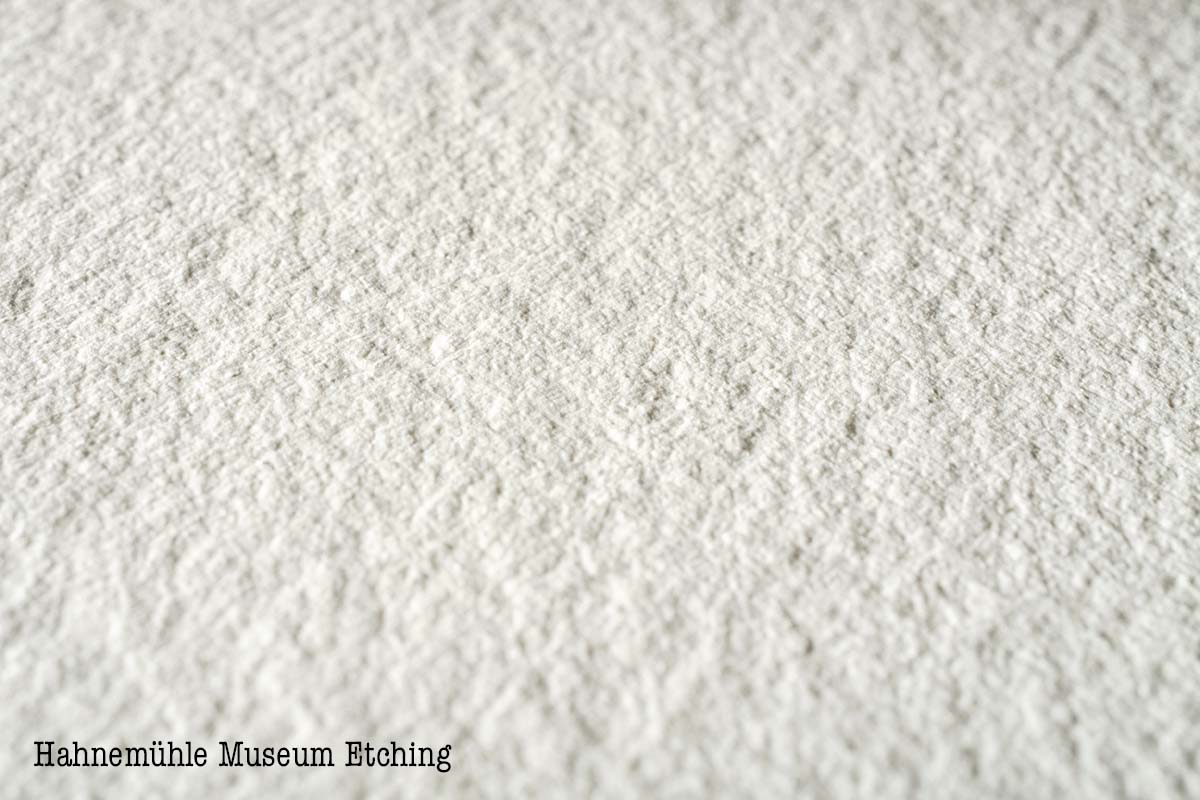
Museum Etching is similar to German Etching but not quite as edgy. If you print a fair amount of your output on this paper - and it is available in quite large sheets - you can invite girls up to see your etchings. I did, and it just shows you what my social life is like. They came up and wanted to see etchings...


There is no disguising the cloth pattern evident in the Monet Canvas sheets - it would be an ideal choice for the sort of art image that one wraps around wooden frames for wall display. Hahnemühle themselves make kits to allow this sort of thing to be done. The kits are very good value and if you can put good colourful images on them you can sell them for a good price. Then you'll be in the Monet...

Not every image suits a rough surface, and not every printer will handle these papers. You need one that can be set so that the paper moves in and out of it on a straight, flat line. You may need to bend or steam the papers to get them to obey. But the artistic effect on the right image is magical...and when you get the trick operating right you can produce print after print the same way.


* I cannot be fürtive about it. I like the ümlaut key. It's fün to üse... 


Labels: , , , , , , ,

Wednesday, January 18, 2017

The Paper Shuffle - Part Three - The Smooth German Connection

 
Hahnemühle are historic papermakers from Dassel in Lower Saxony. With a lot of small creeks ( " bachs " ) running through the place and forests nearby, it has proved to be a good location to make woodpulp and paper - they've apparently been doing it since 1584.

Currently there is a wide selection of papers that have been turned to the inkjet printing application from the company. Camera Electronic have had them for years and supplied some very special surfaces in large flat sheets. As well, there are rolls avaiable for the larger inkjet printers.

The Hahnemühle sample books have always been amazing things - exotic surfaces and extremely well-printed images that make you jealous. As well, they produuce a number of sampler packs to let people assess the things for themselves...but therein lies a problem. What are you supposed to be looking for and how will you know it when you see it?

Add to this the artistic question of what image suits which paper and you have a pretty wide field of speculation. I'll admit to buying a pack of Hahnemühle paper a few years ago based upon the name of it and a mistaken assessment of my own printing skills...and disappointing myself. But the story did have a happy ending - I eventually found which of my images would suit the surface and got the last 5 sheets of the packet to print perfectly.

Well, here's the smooth surfaces under the examining lens. Remember that these are all matt and will need the matt ink option - plus they will not quite get to the black of a gloss surface. But they are stylish and marvellously sturdy - a print on the 308 surface has a really impressive feel.


See the lay of the Rice Paper?


The 220gsm and less emphasised texture of this Photo Rag Book & Album means that you will be able to pack more pictures into the album and any text printeed with the image will be easy to read.


Bamboo. It is not necessarily a surface dedicated to Asian images...but the classic look of misty mountains and clouds would be well-suited to this broken surface. The disruption of it would probably suit rural images with natural shapes better than urban ones with man-made straight lines.


Ah, here we go for that technical image. The Photo Rag Ultra Smooth is 305 gsm but does not raise as many irregularities on the surface and would not disrupt fine detail.


The classic Hahnemühle fine art paper, Photo Rag 308 is often seen with the big roll printers. It supports some of the best landscape art in this state as well as commercial portraiture. See how it breaks the light just that little bit more than the Ultra Smooth?


Disregard what your screen or my camera shot might say - this is a noticeably whiter paper than the 308, as wll as picking up a little more weight; 310gsm.


I cannot say what this Daguerre Canvas looks like with an image because I have been told that my printer will not print canvas. I've been told a lot of things in the past few years but gone right ahead and done them anyway. I'll tel you what happens on a future post...

And that is the idea of these sample packs.They're A4 with two sheets of each surface in the parcel at a bargain price. You could do far worse than just getting a pack, going over your pictures for suitable art, and putting them through your printer. Hahnemühle have the profiles on-line, and they will be necessary, but that is easily done.


Labels: , , , , , , , ,

Tuesday, January 17, 2017

The Paper Shuffle - Part Two - The Ilford Part Of Town


Ilford have had a colourful business history over the last deccade but they have never stopped producing the sort of inkjet paper that is a standard of the industry.

Students, amateurs, and professionals have all been brought into contact with the Galerie series of inkjet papers at some stage of their careers. Whether in cut sheet or rolls, this paper has gone through printers from all the major manufacturers with very little trouble...indeed I think it would be fair to say that the standard Ilford papers are never the cause of printing problems - any difficulties people experience can be put down to printer, ink, or computer instructions. Or operator error...

There have been a number of Ilford options with especial composition - We had the Silk Mono and the various Fine Art surfaces for a while, and there are sample packs right now in the shop with 4 variations of art surface for people to try...but the old stagers on the Inkjet rack have always been Galerie Smooth Gloss and Galerie Smooth Pearl.


Here's the Smooth Gloss under the Tokina macro lens with glancing light from an Elinchrom studio flash:


You can see dust particles but no real texture. Ink flowed onto this surface with the correct profile sets quickly and stays precisely where it is squirted. Ideal for extreme detail.


Here is the Smooth Pearl:


It is a slightly nubbly surface, if that is a permissable word, but note that the thing still has a sealed surface - ink will not spread sideways though there is a little more texture. The effect visually is the reduce the sudden glare of a light illuminating the surface and to slightly lessen the blackness of dark shadows. Subtle, but there.


Now here is a matt surface from the company - Smooth Fine Art paper. It is double sided and makes an ideal substrate for studio-made greeting cards and small handout brochures.


A great deal more breakup on the surface and a noticeable "lay" or grain direction in the paper. You see it running toward you in this view, but the way the sheet was orientated in the test rig means that you are looking across the sheet from the side rather than down from the top. The grain direction is consistent in the packet.

The surface is open, as befits a matt paper, and will absorb more ink - a factor that is taken into account in the dedicated Ilford profile. It also needs, in some printers, ink that is dedicated to the surface. My Epson R3000 uses their MK 157 ink for this and every time I need to print on this sort of matt surface I need to change ink. The Epson Ink Division accountancy department loves this...

Note that though the surface is more absorbent, the paper is extremely dense, and will not show bleed-through to the other printing surface.

Ilford supply the proper profiles for these papers on-line and you can route the information through to your printer easily. The other method - letting the printer deal with the paper on the basis of an internal profile that has been worked out for another proprietary paper - is unofficially successful too. I have let the Epson treat Ilford paper as if it were similar Epson paper and it has worked out well, but you never read that here...

Finally - as a comparison, here is the surface of standard Reflex copier paper - the sort of stuff you print letters and invoices on:


Poorer colour, more absorbent, less ability to render blacks, and floppy texture. You will not make a masterpiece for your club competition on it...


Labels: , , ,

Monday, January 16, 2017

The Paper Shuffle - Part One - Lost In Space


If you are an old-school photographer like me you may occasionally be lost - lost on the back streets of  a new suburb at dusk before they put up the street signs, or lost for words at the latest horrible hipster trend...or just lost when it comes to which inkjet printing paper to use.

In the DOD ( Dear Old Days ) of fibre darkroom paper there was Kodak, Ilford, Fujifilm, and Agfa. There were 3-5 grades ranging from too soft to too hard, and there were imaginatively-named surfaces. Most of these were due to commercial imagination and you only ever printed on them once...but you could always fall back to matt, lustre, and gloss and find something for your film image. Single or double weight was a choice you made mostly on economic grounds.

 The advent of resin-coated paper was either wonderful or horrible, depending on whether you had water and time. The surface choices decreased.

Then the inkjet papers came along - and all of a sudden we had to figure out what gsm meant and what a profile was. Most of us still don't know what this is but we faithfully do what the paper makers say to do and generally things work out. I have adopted the sensible approach of letting the printer decide what it wants to do - the same approach I take to the relatives and the cat - and I am satisfied with the peace of mind.

But there's always that desire for a little more science - for a little more precision in the process. It has driven more people than I mad, so I am not willing to engage in the worst of the geekiness, but I have decided to look closely and see what it is that we are being given. I've no lab facilities but I do have a studio and I've decided to see what studio light can tell me about the printing papers that are on offer.

The methodology will be to to use grazing light to skim the papers while taking a macro picture of the surface. I do not expect to see much variation in the smoothness of a glossy paper, but I am curious to see what the pearl and lustre surfaces look like. The rougher and wilder papers are next after that - right down to the hand-laid ones.

I also want to see what relative amount of reflectance the papers send back, though the measurement may prove difficult. Not interested in percentages or numbers - interested in the look of the thing.

Finally, I want to see whether the gsm rating really does translate into a practical indicator for stiffness in the final product. I have long admired the stock that printers use for business cards  and other signage and have looked in vain for it in the inkjet papers. Home-made business cards, fake drivers licences, and eviction notices just do not have the dignity of the ones made on offset presses if they do not have the same crispness.

And no-one likes counterfeit money when it is soggy. I have had limited success with my line of  $ 7 and $ 8 Australian notes despite the colourful artwork and the choice of Australian Idol contestants as figureheads.

This column will publish results in a forthcoming series.

Uncle Dick


Labels: , , , , , , , ,

Tuesday, July 19, 2016

The Bargain Harman For the Prudent Printer


Normally when I receive goods into my studio for illustration I finish taking the pictures and then carefully repackage them for return to the shop. In the case of this box of Harman Crystaljet Lustre RC paper I might just pay them for it and keep it for the production room. It is that good.

I have used a number of Harman papers before - including a box of this type some time ago-and I am impressed with the way the surface takes the ink and with the fidelity that it has to my screen.

I know the colour management and printing experts scoff at this and say that I should be able to minutely adjust the computer, screen, printer, paper, and ink with scientific formulae and careful measurements so that I could get an award-winning panorama on toilet paper. I must put in the hard yards - when the going gets tough the tough get going - and a calibration in time saves nine. Rah rah. I just want to poke a piece of paper in the Epson R3000 and get a good print in one pass. The Harman will let me do this.

I am at a but of a loss to know quite why one paper is a smooth pearl and another a lustre. And another a semi-gloss. They all break up the light a little and they are all pretty forgiving of most of the types of image that you may put on them. If you can't afford to keep racks of paper choices, get one of these and make it do.

The good thing about the harman is the price - under $50 for 100 sheets of A4. If you addicted to test prints and go through a great many evocations before you finally accept her result, this means you get about 40% more shots than with comparable papers from other sources. If, like me, you are sneaky and do your test prints on an A4 by quartering it and passing it through the machine 4 times:


You can go even further. That's Dr. Sun as a statue in Singapore.

But you have to candidly admit that the process of colour printing with the inkjet is nowhere near as arbitrary or confusing as the CYM subtractive printing of the RA 4 chemical era. If you could manage that, you can print on an inkjet with one eye closed and the other reading a novel.

Harman Crystaljet in store right now.

Labels: , , , , , , , , , , , , , ,

Monday, June 6, 2016

When To Use A Pro Lab - 350 Reasons


The new digital photographer can be forgiven for being confused by any number of aspects of the sport - there seem to be so many to learn.

He or she used to be confronted only by which film to use, does the orange needle match the mark on the light meter, and is the Chemist open so that I can drop my film in? Then in two weeks it was should I buy another roll of film or a bag of barley sugar and box of bandaids?

Now it is white balances, tonal curves, video frame rates, colour spaces, and all the rest. No wonder they have started putting an " Automatic " setting on new cameras and dedicating a knob or lever to it. The relief for some shooters must be palpable.

It is nearly the same for the shooter who wants paper prints of their work. What do they do now that the chemist has gone out of photofinishing and reverted to selling overpriced vitamin supplements and something for the weekend? What are the alternatives with that card full of images?

a. Print it yourself at home on a multifunction printer from Officeworks. No, please - go ahead and do it. The printer will only cost you a hundred bucks and you'll be so disappointed with the results that you won't even have to buy expensive ink cartridges later to try again. The larger multifunctions make attractive pots for cactus.

b. Get Officeworks to print it for you on their big machine. This sometimes works to some extent if your file is perfect and your need is modest. Do not expect art. They are not going to correct your flaws. GIGO.

c. Get an Epson photo-quality printer and do it at home. This works. Start off with the Epson Surecolor SC-600 and move up to the SC-800 if you want larger prints and cheaper ink. Then cast your eyes at the even larger range of large format printers from the company. They will not be cheap but their quality of print is professional and you can be sure that the prints that emerge with K-3 ink on quality Epson, Ilford, Permajet, or Hahnemuhle paper will be be permanent and accurate.

But sad to relate, you are still going to have to be doing a good job with the files. You'll be telling the computer what you want, but you'll have to make sure your monitor is showing you the truth. ( Hint: Spyder colour calibrators, EIZO screens...) And you'll have to make sure that the computer tells the printer the right thing to do ( Hint: either, you, the computer, or the printer will have to manage the colour. Decide early.) And you'll have to make sure that the printer knows what paper you're using ( Hint: paper profiles.)

You will also need to ensure that you put the paper in the right side up. Do not ask this writer how he knows that. Take it for granted that he knows...

A little unsure about all the settings and alternatives? Then you need the Automatic solution...

d. Take the files on a hard drive, CD, or memory card to a professional photofinishing lab. They have not disappeared with the advent of digital - in fact the good ones are going strong because they are the good ones. And they are resourceful, technically skilled, and helpful.

A visit to a professional photofinisher like Fitzgerald Photo Labs at 350 Fitzgerald Street, North Perth
is almost as easy as it used to be to put your films into the chemist. There are real people there who can look at your files and advise you on the optimum sizes that they can be printed. They can suggest paper surfaces for larger works. They can frame the bigger prints - and there are so many options for modern display that you can never run out of a fresh decor idea.

They are able to handle film needs as well - lots of people still shoot on film - and converting the negatives and transparencies to digital files is easy these days. You can get your work back in dual form - digital as well as paper print.

Again you can be sure that the pictures you pay for will be permanent. The big labs use Epson K-3 ink on their big machines.

The joy of a big lab like Fitzie's is that the printing people are there to talk to you and they know what they are doing from long experience. It is not just machine minding in a large furniture or discount store for them. Their job is a profession and they produce professional quality - and that's why Camera Electronic depend on them for our advertising banners and promotional prints. These need to be right and they ARE right.

For those of you  point out that I have forgotten the discount store and the furniture shop...well I remember them when I need tee shirts or kitchen chairs. But not when I need good quality photofinishing.

Labels: , , , , , , , , , , , , , , , , , ,

Wednesday, August 26, 2015

Two Sides Of Two Papers - New Ilford A4 In Stock


Sometimes the humblest of products can be exciting.

Witness the two new boxes of paper from Ilford - we received supplies of double-sided matte paper this last week:

1. Ilford Galerie Prestige Fine Art Smooth.

A4 size and 220 gsm. Smooth bright white on both sides. boxes of 25 with the gold label. Appropriate profile in the Ilford website.

2. Ilford Galerie Prestige Fine Art Textured.

Again A4 size and 220gsm. This one has textured bright white on both sides. and again there is an appropriate profile for it.

Ilford media is the standard of he industry for many applications - this matte paper and Epson, Canon, or HP inks and printers wold make very good art book and presentation material.

Of course there is always the extra concentration one needs when making anything double-sided - you need to be careful with borders and spacing and remember to get your orientation right before you push the 'print' button. I have made a number of errors in all these things over the time and it does teach you eventually - at a price.

In any case, these are not punishingly expensive papers - you can experiment and delight yourself.

Labels: , , , , , , , ,

--> Camera Electronic

Camera Electronic