Monday, March 13, 2017

Tune-Up Time With Manfrotto


How many of us get a tool kit with our new digital cameras these days? In the old film days it was common for the box containing the SLR or rangefinder camera to have a complete tool pouch including a stilson wrench, set of spanners, lens brace, film jack, and a bottle of optical antiseptic. In the case of some Kodak cameras you got a 8-round clip of .30-06 ball ammunition and a toothbrush.

I think we are being done - nowadays you're lucky to get a battery charger and a squidgy little lens cloth with some. Even the instruction manuals are on a CD...or are a web address.

Well, all that having been said, it is refreshing to see that Manfrotto, the famous Italian tripod and lighting accessory manufacturer, has realised that users of their equipment still like to be able to maintain the goods. Their recent carbon-fibre monopod model is a...well... a model of a good product. It works and will keep on working.

The monopod idea is brilliant for anyone who is toting heavy cameras or lenses and needs some relief from the weight. I spend 4 hours shooting dancers on WA Day with a long zoom and a heavy little camera. The Manfrotto monopod I use - an early cousin of this one - takes all the weight out of my arms and puts it down, while not occupying a big triangular patch of floor. Makes the difference between an easy job and a arm breaker.


Well, like some older Manfrotto CF tripods, this one has three lever claps to adjust the sections. Far faster than screwing the sections together like some cheaper monopods. As they are acting on springs, there will come a time when they grow weaker, and need to be adjusted. This is where Manfrotto have been smart - they moulded a plastic box spanner onto a grip and clipped it to the shaft of the monopod.


If the weather changes or the equipment ages, you just tighten up as you go.

Brilliant. Combine it with the Manfrotto 234 or 234RC tilt top and you've got the smartest quick support in town.

Labels: , , , , , , , , , , , , , , ,

Tuesday, February 21, 2017

Don't Be Shortsighted -Try A MIOPS Pic...


I have waited a decade for a straight line like that...you may also have been waiting a similar length of time for an easy way to make special effect shots with your digital camera. Well, the time has come - the MIOPS is here.

Over the last few years there has been increased interest in doing spectacular shots - capture of lightning as it strikes - lightbulbs and balloons shattering - time lapse sequences  - sound and motion activated photography - etc. Some of these images have always been possible - even in the film era -  but the amount of equipment and specialised knowledge to arrange them has been staggering.

As an example, most photographers have seen Dr. Harold Edgerton's stoboscopic pictures and experiments with flash in history books. Or they have seen Muybridge's studies of animal motion. The results are pedestrian now but were revolutionary at the time, and the amount of grear and mechanical setup that was needed to get them was far beyond what you could carry or afford.

Lightning shots have been done for over 100 years, but not reliably and not easily. You generally had to stand out in an open field while Ben Franklin got his kite in the air...Climbing to the top of the church steeple with a metal umbrella in the middle of a thunderstorm was also a possibility but generally it was the sort of thing you only did once...

And chasing pictures of elusive wild animals in the woods? Baits and blinds and trip wires and telephoto lenses and crawling around in a ghillie suit to change the glass plates...The only simple way to get wild animal shots was to sit in a tree during bear season and make a noise like a bucket of blueberries.


Okay. Now it is the 21st century and you have a digital camera with an electronic trigger port. Canon, Nikon, Sony, Pentax, Olympus, Fujifilm....whatever. If it has a socket for a cable release you are in business. You also need a mobile phone - iOS or Android - and a teenager* to show you how to get an app to work on it.

You also need the MIOPS controller. This little box contains the ability to do sound and light triggered exposures  ( There's your lightning and pistol shots taken care of. ) and it will sit there and do the multiple shots over a very long period of time that the time-lapse photography requires. You don't need to sit there and fire the camera every 5 seconds or so - you can go about your business while it does the monotonous task.

You can get it to respond to laser beams of light or to the sudden interuption of a light beam - here's your chance to leave it in the woods for those wildlife shots without sitting up the tree. You can set up a light trigger beam to capture images of intruders. You're only limited by your imagination and several inconvenient statutes...


The MIOPS is powered by a good - sized lithium rechargable battery so that it can be on duty and responding for a long time. It is equipped with a shoe mount as well as a 1/4" tripod screw socket so you can securely couple it to the camera. There are dedicated connection cords for a number of popular camera makes - the one you see in the illustration is for Canon. Bless them, they have made the cord as well as the controls and port covers in bright orange so that you can see them when you are out the back of Doodlakine at midnight on a astro-shoot and it is as black as the inside of a cat. Would that ALL manufacturers of cords, wires, and connectors for studio use followed the same lead.

As far as controlling the controller, that is where your mobile phone comes in. The days of complex codes and strange computer words are gone - Bluetooth couples the MIOPS to your phone and as soon as the teenager gets the app into the phone, you can use it.

Expensive? No. About 60% of what this sort of thing used to cost and about 600% easier to use. And in-store right now - no need to try to find something on the internet. Save your internet time for reading this column...

* Or you could get the Camera Electronic staff to show you how to do it. They are like teenagers but without the sarcasm and eye-rolling.

Labels: , , , , , , , , , , , , , ,

Tuesday, January 24, 2017

The Long Lens Inside - The Saga Of The Fujifilm Continues


If you read most of the photographic press that deals with interchangeable lenses for DSLR and mirror-less cameras you'll see much the same recommendations about choices. It's not conspiracy - it's sensible agreement. Being photographers we are free to be neither sensible nor agreeable - and sometimes it pays off big-time.

The books all talk about long lenses being the sensible choice for motor sports, surfing, field sports, wildlife, and aircraft photography. I've not gone in for a great deal of these subjects, but when I have the advice was good. You need long focal lengths to bring in lions and Tiger Moths - you also need bright light. Anything less is going to be a failure.

Oh yes? Well what if you get an assignment to take pictures at a Halloween dance show in Fremantle -at the Fly By Night hall on High street. That's a picture from the mezzanine balcony at the head of the column. Great place to prop up during a performance as you are in no-one's way, but a long way from the stage...Note: The establishing shot is a Fujifilm 18mm f:2.


Enter the Camera Electronic Rental Department and the 100-400mm Fujinon zoom lens - the big boy in their lineup. Widest aperture is f: 4.5-5.6 but it has a dynamite optical stabilization circuit inside and an extremely smooth focus. The support shoe and rotating ring are also super-professional.

I bolted the lens onto a Manfrotto 234 monopod tilting head and in turn supported that with my Manfrotto carbon fibre monopod. Sitting on a chair up there in the gods at the Fly meant that I was stable and the lens was too. I could even grip the monopod with my knees if I needed to busy my hands elsewhere and the whole assembly stayed upright. I love tripods in the studio but am starting to love the manfrotto monopod more when I am out an about - so much less hassle but still great stability.


Okay, it's dark in there, and the stage lights are good but still not the same as sunlight. ISO up to 6400 on a Fujifilm E-X2 is as high as you want to go, but fortunately it was high enough to work. Really fast dancers blurred, but slower ones came in well. And the transition from landscape to portrait orientation couldn't have been smoother - I just kept the lock knob turned off and rotated at will all night long.

The job was a lot of fun - Halloween brings out the theatre in people and if they are good actors, singers, and dancers to start with it is all that much better under stage lighting.


Note: If you've got a job that needs long coverage think about talking to the Camera Electronic Rental Department. They've got faster lenses for other systems as well, or if you would like to try the latest and best from Fujifilm, ask to see the X-T2 with this lens. You could even add a teleconverter to push it out to 600mm.

Performers, Nina, Richell, and Jenier. Thank you for a great night, ladies.

Labels: , , , , , , ,

Thursday, January 12, 2017

The Game's Nearly Afoot, Watson - With The Olympus Long Lens


NOTE TO READERS: THE ELECTRICITY HAS BEEN OFF ALL DAY DUE TO SHORTS OVER THE LINE. IF IT IS STILL OUT IN YOUR SUBURB, DON'T BOTHER TO READ THIS MESSAGE...ALL BACK ON HERE AT THE EDITORIAL OFFICE...

Well nearly a foot. 11.81 inches to be precise...

That's the focal length of this Olympus 300mm f:4 IS PRO lens - I didn't actually measure the thing from front to back. It is one of the longer choices that one can make for the Micro 4/3 system. Olympus and Panasonic users with a desire to pull in long distance images are the market.


You? Do you shoot sports? Cars? Surfing? Aircraft? Large wildlife? Birds? Well step up to professional qaulity and take this lens away.


But wait - there's more. As I found out a week ago in the dim reaches of the Fly By Night theatre in Fremantle, theatre shooting can also be done with this sort of camer and lens. Boost your ISO, put the thing on a monopod, and blaze away. The 300mm is more than long enough for most theatres.


But wait - there's more. As I discovered when I pulled the focusing ring backwards on the mount, this is a long lens with a rearkably short minimum focuss distance - just under 1.4 metres. Any object seen at this close distance under the magnification that his focal length gives will be pretty large on the sensor. Remember that in terms of the old 35mm film geometry, this is a 600mm lens!

Depth of field will be shallow under these criteria, but that is optics.

The heading image is just bcause it is a lovely piece of glass to look at. The lens hood is attached to the lens and just slides forward into position.

Note the feature of a " industry-standard " profiled mount on the tripod support foot. I used a similar idea for mounting a zoom lens on a monopod and it is the height of convenience and elegance.

Labels: , , , , , , , , , ,

Monday, January 2, 2017

Sirui For The Serious - Part One


Sirui? Are you serious? Sure we are.


The larger of the Sirui tripods that appeared in the Little Studio turns out to be a compact design - the company recognizes that people are travelling more these days and need to travel lighter. We also know that they may be travelling with the DSLR rather than the mirror-less systems - hence the need to hold heavier loads.


The Sirui T 2204X and the Sirui K30 X are partners - albeit partners that you have to purchase separately and mate together. They are designed for supporting the larger system cameras while still retaining lightness and compact size themselves. These are components for people who are going to stand at the airline counter and look over the excess-baggage price list with nervousness.


The tripod starts out as a carbon fibre design with screw-lock legs. The yoke is a lightweight forged casting - more weight saved. It folds back 180º into itself for space saving. it packs into a nylon case with the K-30 X head still attached.


You might just get away with it in the cabin locker or at least not get charged extra in the hold. Give it a try and remember to be pleasant - you never know your luck.


The whole rig only weighs 1.9 Kg all up and can support up to 30 Kg. You want to ponder going out in the morning with 30 Kg of photo equipment stacked around you - mainly ponder what you'll feel like as you come back at night. Perhaps best to take only three giant telephoto lenses out at a time, eh?


Whatever the state of your joints and back at 6:00 PM at least you will know that the Sirui T 2204X / K30X combo is not responsible for the pains. Hope the pictures come out okay.

Labels: , , , , , ,

Friday, December 9, 2016

The Blue Bag Of Happiness


I am curious about the blue bag syndrome. Many manufacturers seem to make them - in varying shades and textures. I have two of them myself by different makers. I cannot say why they should be blue rather than brown, purple, red, or green. I could understand if they were bright yellow or orange for use in snow conditions or at night, but the other colours puzzle me.

Well, that aside, this Photo Hatch II Aw from Lowepro is a pretty good choice for the sorts of people who wear backpacks - and I don't mean to sound funny saying that. Let me explain:

Backpacks can come in all sizes and shapes but some of the most common ones are Too Big, Too Small, Too Floppy, and Too Stiff. The people who choose them are either confronted with inappropriate carrying capacity, awkward fit, or downright pain as hard edges dig into them. The idea for which the pack has been bought frequently goes out the window as wrestling with it overtakes all other considerations. In some cases the bag acts as a buffet for the thieves of the area and in others even the owner of the thing cannot get inside to get the camera out.


Like Baby Bear's porridge, this Lowepro bag has nothing too extreme - it would suit most hikers in most day situations. While you'd not select it to haul all your camping gear for an arctic yomp, you can make day trips into rain forests and deserts quite well with it. It would not be an unreasonable size to carry for an urban expedition, either. In this latter role, perhaps the blue colour has been chosen to let it look a bit less imposing.


It's the basic top general storage and bottom camera storage that we have seen so many times from Lowepro. In this case the designers have chosen to allow access to the top from a general zip over the crown of the bag but have adopted the strategy that they used in their Flipside series - a zipped flap to access the cameras that can only be opened when the pack is off the body. This is also known as the South American security design.


It is also rip-stop fabric with a full weather cover stored under the base of the bag. There is a tablet, papers pouch at the most vulnerable part of the rear face, so you might need to monitor your surroundings. Losing your sandwiches and jumper is one thing but your devices and passport is another.


One feature I did like is extremely simple - there is a reflective panel set into an accessory strap on the rear face. Whether you loop something through there or not you can at least be seen hiking on a highway for a considerable distance if vehicle lights pick up that patch.

Also note one more thing on that patch photo; the stitching. Even, spaced, a good margin, and hemmed edges. This is the good stuff, folks.


Labels: , , , , , , , ,

Monday, October 24, 2016

The Gambol With the Gimbal


Never gamble with your gimbal when you gambol with the sambal...the deer that is, not the hot sauce. You're on your own with the hot sauce.

The product today is mechanical, rather than optical. It has no glass in it, but several moving parts. It is second cousin to a gun mount, but not nearly as noisy.


The underslung gimbal mounting  - also known as a Wimberley mounting after one of the many makers - is a form of suspension for specialist use in photography. Shooters who want to use long telephoto lenses and who need to follow the movement of wild animals, aircraft, racing cars, surfers, or field sports players will be interested. It is the answer to a number of their needs.

At this point let me introduce an analogy that was explained to me when I asked about the differences  flying helicopters as opposed to fixed-wing aircraft. I was asked to think of a large imaginary bowl in the sky - hemispherical and slippery.

The fixed-wing aircraft rides inside this bowl. If it is up on the inside surface of the bowl...in a bank, turn, or climb - and the pilot lets go - the plane runs down the inside of the bowl and settles into a stable position on the bottom.

The helicopter rides on the outside surface of an inverted bowl. When the pilot takes his hands off the controls the helicopter falls down over the outside of the bowl. The pilot needs to fly it all the time.

The operator of a big, long, heavy telephoto lens mounted on a ball head tripod is in the same position as the helicopter pilot - the lens is either held up all the time or locked in position. It is unstable. Gravity is trying to take it off centre.

The underslung mount is generally on a tripod, but when an unwieldy lens is mounted, natural forces cradle it at the bottom of the arc of swing on the mount - it retuns to a stable position. It is much less fatiguing to watch and wait with it.

This example of the underslung gimbal is by Promaster and is a marvel of economy. It is heavy and precise enough to stand the long commercial lenses, however it has smooth damped action as it swings about. It is like operating a good gun mount.


Like a gun mount, it has marked divisions on the turntable and on the horizontal axis. I can't really say why they are there because most photographers would not fire their cameras to instructions from a director, but perhaps they are there because it looks cool. The mounting platfom rises up and down to accommodate different lenses and there is a channel grip at the bottom of it that is stated on the box as " industry standard ". They really mean Arca -Swiss but they don't say it because I'll bet their lawyers warned them off.


The whole assembly is well made and would be a good alternative to a ball head or three-way for the nature and outdoor shooter.

Labels: , , , , ,

Tuesday, October 18, 2016

The Travel Trail - Panasonic Part One - The Silver Style


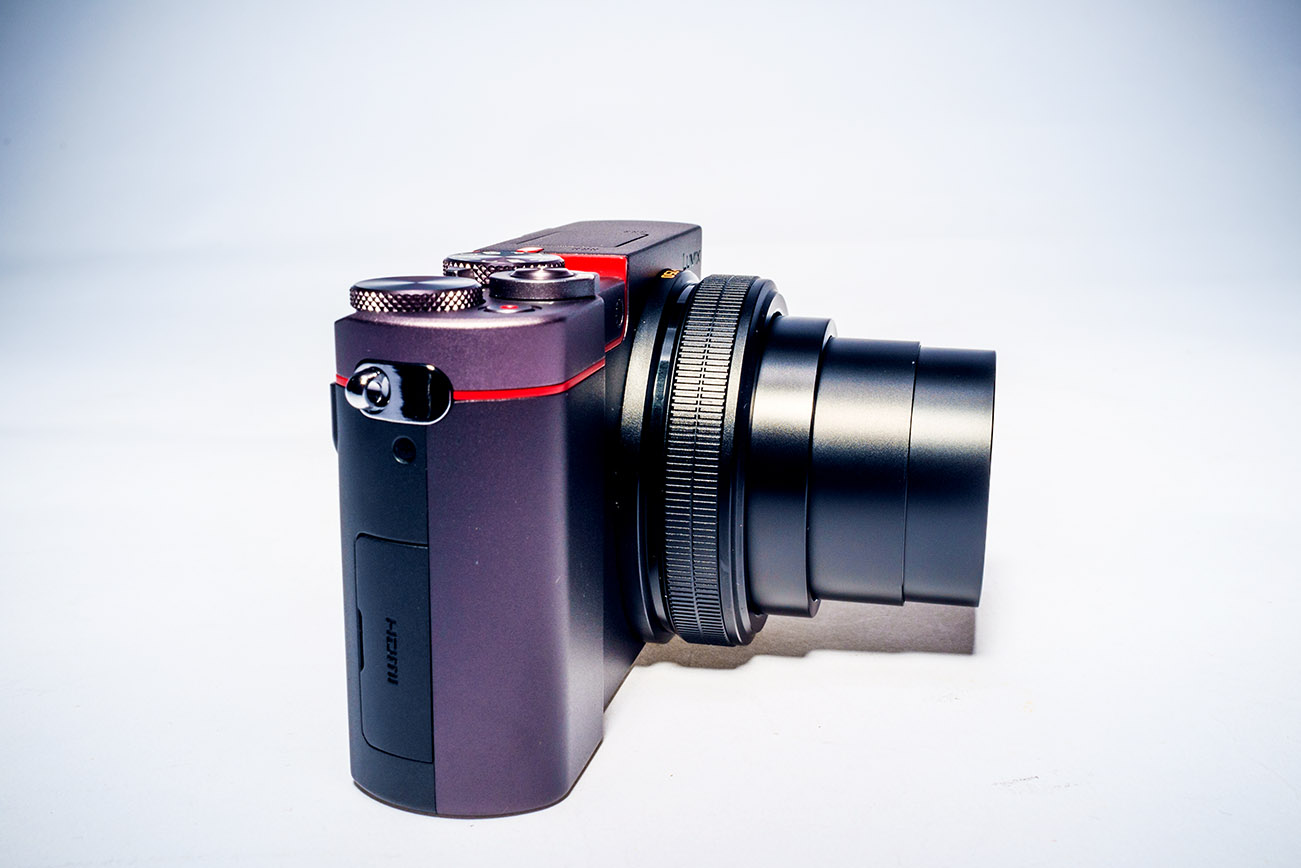
Today's Travel Trail brings us one of the more stylish of the Panasonic compact cameras. Those of you who have an eye to fashion may wish to look closely at the shape and colouration of this...

The Panasonic Lumix DMC TZ110 box says "Silver" but that is a kind of inadequate description for what looks very much like a two-tone titanium finish with a red accent stripe separating the different colours. Of course you can get these cameras in black, but the appearance of this on is so appealing that it rivets the eye instantly. Will we ever get past black boxes completely? No - but this is a good start.


The camera is the type that has a fixed zoom lens and provision for eye-level viewfinder as well as LCD screen viewing. For the tech-conscious it has a 1" sensor and 20.1 megapixels MOS sensor. The lens is a 10 x optical zoom that gives you the angles of view from the classic (35mm film classic) 25mm wide-angle to 250mm telephoto. This instantly identifies this as an overseas travel camera.


Why? Because you need a long lens for Alaskan bears or African lions. And for surf shots closer to home. Of course you can take anything with the telephoto and bring it in closer, but the traveller who wants to do the world circuit with the least encumbrance of gear is the person for this camera.


Now remember that you can also shoot night time, parties, restaurants, family, and an amazing number of Australian travel photos with a smaller camera like this. The fact that you are carrying that much zoom power in pocket or purse means you are never caught wanting when something develops.


On a more serious technical note, the camera shoots 4K video - the current standard of excellence. It is literally a one-button process. The fact that the camera can shoot 4K means that Panasonic have also been able to do something rather magic - they have made arrangements for small bursts of recording that take different focus points during action sequences that let you go back later and select the exact peak of focus. Here's where the sports people faced with a moving object will cry with joy -no more missed shots.


Of course Panasonic have included a number of fun programs in the mode dial - panorama, miniature effect, picture effects, etc. Macro, stabilisation and WiFi are all included. Quite frankly, this camera and a small tablet are all you need for a world trip, and that is two pockets and a space in your luggage for the charger (I pack mine in my spare pair of shoes...), a spare battery, some cards, and a "I don't speak your language" app on the tablet should do it. If you get taken for a rich tourist by the look of the camera you'll have to talk your own way out of it.

PS: That's a no-joke Leica zoom lens made by some serious Panasonic workers. I know- I saw 'em being made.

See the Panasonic Lumix DMC TZ110 on the Camera Electronic website 

Labels: , , , , , , , , ,

Wednesday, September 21, 2016

Kit Without Being Kitsch - the Fujifilm 18-55 lens


Sometimes you look out over the vast heaving sea of camera lenses and all you can see to the horizon is...kit lenses. Whether they are attached to Canon, Nikon, Olympus, Sony, or Fujifilm digital cameras*, they are there in serried ranks - ready to head out to take the initial shots.

People sometimes think of them as stop-gap measures...lenses that you use until you can purchase something bigger and longer and faster and more expensive...training-wheel lenses, if you will. Well, as a camera shop we would never discourage you from buying more lenses, but we can let you into a litle secret at the outset...kit lenses are very good.

It's percentages really - you can say that, for an average shooter, the camera set at factory defaults and on an automatic setting will deliver the picture they want about 85% of the time. It's the same for the kit lens - Average Joe or Average Jane will get what they need 85% of the time with the kit lens - particualrly if it is an 18-55mm focal range for an APS-C camera.

Of course as they advance in knowledge and skill, they become Excellent Joe and Excellent Jane and find they need wider, faster, longer, closer, etc in their lenses. And they can expect to pay more money and we can expect to take it. Isn't nature wonderful? But there is still a solid foundation of goodness in that kit lens.

The 18-55mm f:2.8-4 R LM OIS lens from Fujifilm can be clapped onto a new X-T2, X-Pro2, X-E2s, X-T10...or any of their older cousins...and for the most part stay clapped on there. It would be a very hard choice to beat for family pictures, casual portraits, landscape trips, holidays, car shots, pet shots, and product shots.

I could do a great wedding with one - I use flash for weddings - and the people who use the higher ISO settings on the newer cameras could do pretty much as well. The facility of not having to change lenses between shots would be priceless. For the techno-geeks out there who point out the inherently higher distortion percentages of any zoom lens vs any prime lens my answer would be: " When was the last time you saw a bride who was made up of right angles? ".

The OIS is the key to most of what this baby can do on the run. Lots of camera systems now have some form of stability aid - some are in the lenses and some in the bodies. This one goes with the Fujifilm idea of having it in the lens - whatever type, the effect is to allow you to use two shutter speeds slower than you could normally hold without paying a picture penalty. It won't take the place of a tripods for some work but it'll get you closer to that decision line than before.

As a trip lens it would be perfect if you were going to do urban and semi-rural pictures. I'd not hesitate to use it as the ONLY lens for a European or North American tour if I was not out in the bear-and-mountain-goat belt. Everything else would be well within the reward zone. Note: for wildlife you need longer lenses and for little life you need the Fujifilm 60mm macro lens. But you knew that already.

The one clincher for a kit lens is the price - they are often significantly less expensive than the exotic lenses in any manufacturer's range. Combine that with their utility and you've got a combo that you can't really beat! They're easy to pickup...( groan...)

*No, Virginia, you can't attach the same lens to all the cameras. At least not without a hammer and bad language...


Labels: , , , , , , , , , , ,

Wednesday, August 31, 2016

We Finally Get To It - With The Big Fujifilm Lens


I have been experimenting for the last few months with long lenses attached to my Fujifilm X cameras by means of adapters. The tests were encouraging as long as there were suitable subjects some distance away. Yet I had never gotten to grips with the long zoom made by Fujifilm themselves - now was the time.


Each manufacturer presents their material in a different way - some go for simple cases to protect their lenses and some go for quite elaborate hard cases. Fujifilm has packed the XF 100-400mm  f:4.5-5.6 RLM OIS WR lens in a sturdy box, a cardboard cradle, and a cloth wrapping...I should advise investigating a Lowepro or Promaster Lens case before venturing out into the field - the lens is superbly finished and it would be a shame to nick it up unnecessarily.


Well, it is certainly big in comparison to the other Fujifilm lenses, but small when you consider the optics of full-frame DSLRs. This would be a great deal easier to haul on long wildlife trips - even with the substantial lens hood attached it is manageable. That's a standard-sized business card there in the zoom picture.

The lens is fitted with the usual controls - dealing with the stabilising system, zoom ring, zoom ring lock, and Automatic or manual aperture. There is one additional control switch that limits the focusing travel if you are only going to play with distant subjects.

The tripod foot is quite neat but substantial.


The surprises on the lens hood come in two forms; there is a button to release the hood gently, and there is s sliding panel on the underside. This is not the cover for the waist-gunner's position, though it looks like it - it is hatch to let you reach inside and turn polarising filters to best effect. Note from the shot of the inside of the lens hood that Fujifilm have even gone to the effort of ribbing it for flare reduction - a neat finishing touch.

But what of the operations? No more fumbling with a manual focus ring with this one - and no more hastily turning a manual aperture ring to stop down just before exposure. Oh sure, you can do it...but you lessen your chances of getting a really sharp shot, really fast. Adapters are all very well, but they are still adapters. It was a sheer pleasure to point and shoot in single-frame and watch it snap into focus.

Here are some shots taken in the open air - no polariser to darken skies. The camera body was the Fujifilm X-E2 with the latest firmware update and I can honestly say the autofocus speed was as good as I could expect. There is always a fuss about this function in sports shooting from the point of view that it is not as fast as a DSLR. Well, it's a lot faster than winding it manually, and not noisy while in operation.


I should still resort to focus trapping at a motor race to ensure that I was giving the mechanism the best opportunity to perform sharply on high-speed vehicles like this one...


Oh, how I wish The RAAF would save enough money to buy jet fuel and have an air show at PEARCE. I would be willing to sponsor a gallon of avgas myself.


Labels: , , , , , , ,

--> Camera Electronic

Camera Electronic