Tuesday, November 1, 2016

Slip Into The Driver's Seat - Panasonic GX-8


Two years ago I was allowed to own a Panasonic GX-7 camera with a 20mm lens for a week and was extremely impressed with the combination. It was an ideal choice for a genteel but thoroughly capable mirrorless camera. The glimpse that I got of the manufacturing processes of the company involved boosted my confidence in the whole concept of the micro 4/3 sensor in a camera.

Panasonic never rest on their laurels, so after a suitable interval they issued the GX-8...capitalising on the design of the 7 but improving the sensor and adding a number of internal features. I am happy to report that the improvements are discernible and desirable. I took one in to the studio for a spin this week to see what it could do.

Note: I forgot to grab a 20mm f:1.7 Panasonic lens when raiding the shelves for the illustration, but as the Micro 4/3 cameras share common lens mounts, a kit zoom from one of their competitors could bayonet onto the body and we were good to go.


The first detail I noted was the change in grip from that of the GX-7. I was leery of this as the 7 had one of the best grips for a medium-sized hand that I had ever encountered. The new camera sharpened the angle of the body in the spot where your fingers curl into it.

Good? Bad? Better? Worse? I am of the conclusion that for some people it is actually better. The fingers grip tighter in the crease and this factor coupled with the resistance in the ball of the thumb gives good stability to the body while freeing up the thumb and forefinger more than before. The shutter button and adjustment wheel are still in perfect positions.


Your focus choices are also placed very conveniently. I use AF out and about but MF in the studio - it is good to be able to switch rapidly without using a menu.


The main command panel has shifted the controls somewhat, with the addition of a compensation dial concentric with the mode dial. Good choice of spot, as it is hard to accidentally twirl it out into the wrong setting...Of course there are front and back thumb and finger dials for important adjustments. The only regret I have is the shift of the on/off button to a front rather than back position.

As an aside, I wonder if the design department that deals with new cameras is divided up into "Thumb Team" and "Forefinger Team" to lobby for the position and importance of their controls. Think of it: ten earnest Japanese men sitting around a table trying to gain prefer for their digit over that of the others...


I was pleased to see that the innovative tilting viewfinder was maintained. it is one of my favourite features for low-level shooting. Of course the camera has touch screen on the tilting LCD panel but this is no substitute in bright sun for being able to put your eye right down to the viewfinder. That said, I do like the fact that you can touch-focus on the LCD screen to shift the AF point. I am always a little clumsy with touch screens but this one does have some merit.

So how does it all work in practice? I grabbed a '56 Chevy Nomad (Car Of The School Teachers) and turned on the new IKEA mini stage lights and tried it out.


The depth of field for the micro 4/3 cameras is superb - probably the best compromise between sensor size and focal length there is for medium-sized tabletop subjects. If you have a hankering to do it in one shot rather than a 2 or 3 stitch, this may be the camera for it. I should imaging a 17mm to 25mm focal length would be the sweet spot of the optical geometry.


The day was also a success with the trials of the IKEA lighting. If course you need to make sure that you measure the colour temperature and set a custom white balance, but after that it is just a matter of  movie the light heads on their gooseneck tubing to set the positions. It is going to make car interior shots so much easier.


PS: I want chrome strips on the back of my hatchback too, but the car agency man just sniffs and pushes me out the door.

See the Panasonic Lumix DMC-GX8 Mirrorless Camera online here

Labels: , , , , ,

Monday, October 24, 2016

The Gambol With the Gimbal


Never gamble with your gimbal when you gambol with the sambal...the deer that is, not the hot sauce. You're on your own with the hot sauce.

The product today is mechanical, rather than optical. It has no glass in it, but several moving parts. It is second cousin to a gun mount, but not nearly as noisy.


The underslung gimbal mounting  - also known as a Wimberley mounting after one of the many makers - is a form of suspension for specialist use in photography. Shooters who want to use long telephoto lenses and who need to follow the movement of wild animals, aircraft, racing cars, surfers, or field sports players will be interested. It is the answer to a number of their needs.

At this point let me introduce an analogy that was explained to me when I asked about the differences  flying helicopters as opposed to fixed-wing aircraft. I was asked to think of a large imaginary bowl in the sky - hemispherical and slippery.

The fixed-wing aircraft rides inside this bowl. If it is up on the inside surface of the bowl...in a bank, turn, or climb - and the pilot lets go - the plane runs down the inside of the bowl and settles into a stable position on the bottom.

The helicopter rides on the outside surface of an inverted bowl. When the pilot takes his hands off the controls the helicopter falls down over the outside of the bowl. The pilot needs to fly it all the time.

The operator of a big, long, heavy telephoto lens mounted on a ball head tripod is in the same position as the helicopter pilot - the lens is either held up all the time or locked in position. It is unstable. Gravity is trying to take it off centre.

The underslung mount is generally on a tripod, but when an unwieldy lens is mounted, natural forces cradle it at the bottom of the arc of swing on the mount - it retuns to a stable position. It is much less fatiguing to watch and wait with it.

This example of the underslung gimbal is by Promaster and is a marvel of economy. It is heavy and precise enough to stand the long commercial lenses, however it has smooth damped action as it swings about. It is like operating a good gun mount.


Like a gun mount, it has marked divisions on the turntable and on the horizontal axis. I can't really say why they are there because most photographers would not fire their cameras to instructions from a director, but perhaps they are there because it looks cool. The mounting platfom rises up and down to accommodate different lenses and there is a channel grip at the bottom of it that is stated on the box as " industry standard ". They really mean Arca -Swiss but they don't say it because I'll bet their lawyers warned them off.


The whole assembly is well made and would be a good alternative to a ball head or three-way for the nature and outdoor shooter.

Labels: , , , , ,

Thursday, October 20, 2016

The Travel Trail - Part Three - You're Going To Like A Panasonic Camera...


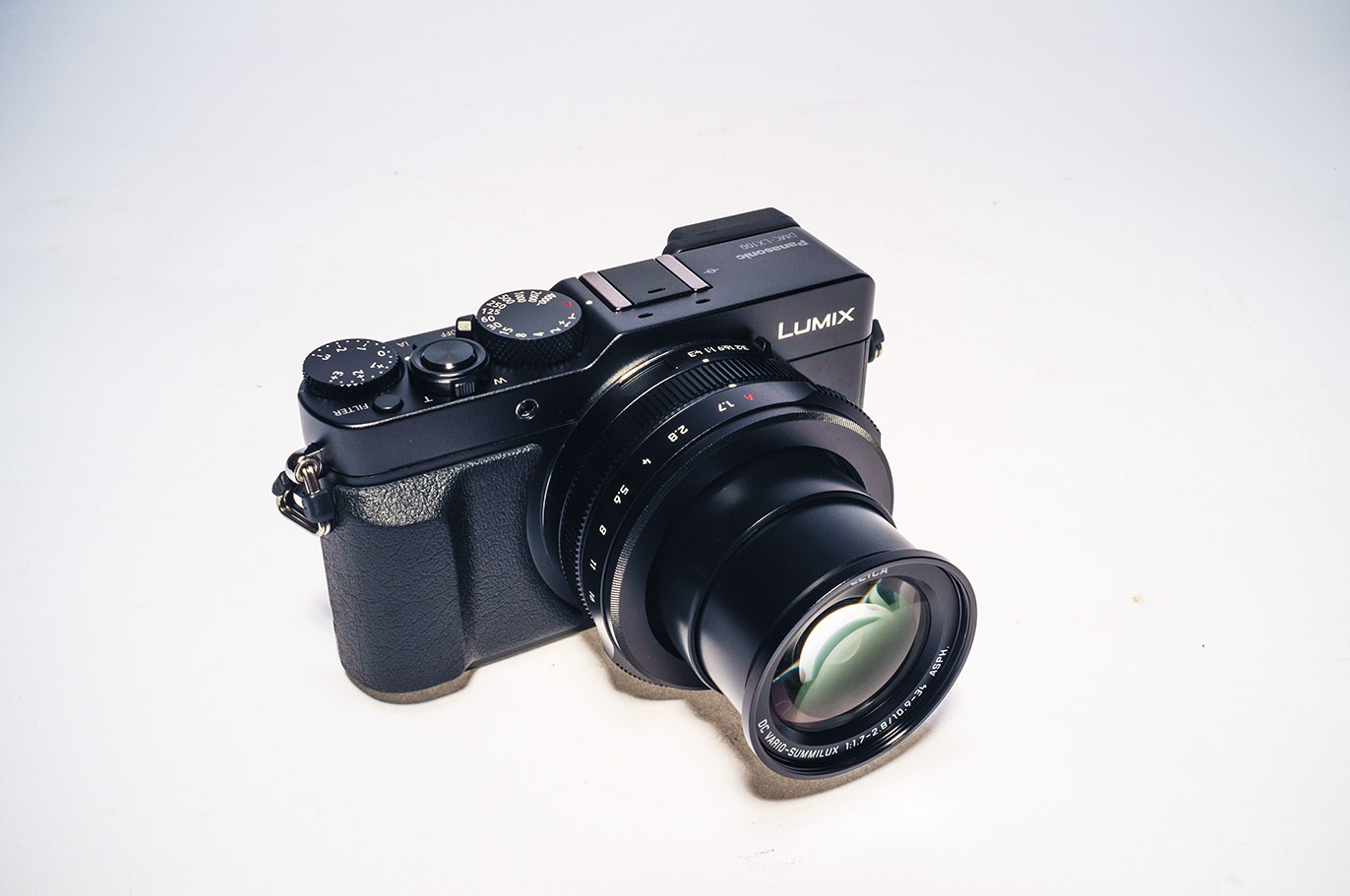
This is the camera that I would travel with...if I were travelling with a Panasonic camera. That's a personal value judgement and you're entitled to ask why - and then to make up your own mind. But here is my rationale for the Panasonic Lumix DMC- LX100:

1. The camera is all in one. No interchangeable lens to lose, no entry of dust or contaminants to the sensor. No cleaning. It is small and neat. It attracts little attention*

2. The lens is a Leica lens. Superb resolution and contrast. Aspherical elements so there is very little chromatic aberration - that is the killer defect of some other lenses for me and puts me off them. This one has no CA that I can see.


3. The lens has a true focal length range of 10.9 to 34 mm. This means that it has a chance of a very wide depth of field for landscape shots...and also for macro shots. The 35mm camera equivalent in the lens is 24mm to 75mm. That is classic landscape without distortion to classic portrait.

4. The lens will open up to to f:1.7 or f:2.8. That's low-light enough for most tourist shots w/out flash. It will stop down to f:16 and there's where the DOF becomes wonderful!

5. The sensor is 4/3" MOS - that's the same a Micro 4/3 size without the interchangeable lens to worry about. It cuts the world into 16.84 megapixels so there is plenty of resolution for A3+ prints....and I'd even test it out to A2...

6. It has an image stabiliser system - as it is small and light it needs something to keep it on track besides my shakey ol' hands.


7. Did I mention the close-up - goes down to 30cm at the tele end and 3cm at the wide end. I can take any details of cars or cannons that I want.

8. In case I want a flash there's a standard hot shoe and I can put a TTL flash on there.

9. 4K video recording for moving pictures. I have no idea what this is. I don't watch TV. I look at still pictures.

10. 4K video recording from which you can extract still pictures. Aha! Now I see where I could use this. I shoot a burst of frames of a Galapagos turtle streaking by and select the best one that is in focus. Interesting.

11. RAW/ JPEG and it's covered by my Adobe editing programs right now.


12. Eye-level viewfinder for the sunny days.

13. Direct control of aperture and shutter speed on traditional dials, with the option of a fast click off into aperture priority or shutter priority. This, camera makers, is the way it should be...always...


14. Quick external option for format change. This is a dangerous switch for the uninitiated as they may move it to a position that limits their results later on...and not realise they have done it. I shoot 3:2 mostly, but shift to 9:16 for big groups and 1:1 for some events where I don't want to be rotating the camera all night.

15. WiFi. I don't use it often, but when I am travelling I do like to fire some images back into the tablet for blogging. If I can do it without card shuffling and extra adapters, all the better.


So there. That's why I would travel with this Panasonic LX 100. As you see I travelled out to Jandakot to see what it did on the runway.

* I attract enough attention in other ways. That steam-powered destroyer siren was a darned good idea.

See the Panasonic LX 100 on the Camera Electronic website 


Labels: , , , , , ,

Wednesday, October 19, 2016

The Travel Trail - Part two - Micro 4/3 In The Hand


The first of our Panasonic Travel Trail cameras was small but capable - our next candidate gains a little in size, but introduces you to a whole system of photography - it is a photo trail you can follow for years...This one is the Panasonic Lumix DMC-GX85.

Panasonic Micro 4/3 system cameras have lenses that clip on and off - you can choose from a wide variety of different ones for specialised or general tasks. And you can use lenses from other micro 4/3 manufacturers - they have all come to agreement on that.

The other great advantage for this camera is the increased size and capability of the sensor 4/3 " Live MOS with 16.84 megapixels. Together with increased processor power this gives increased detail and resolution and you can blow your pictures up larger.

As with the smaller Panasonic camera, it has the 4K video recording and can also benefit from the post-focus selection system when you take a fast photo burst in 4K.


You'd like Wifi? It's in there. You'd like to control it remotely with your smartphone or tablet? There's an app for that. Want the convenience of a touch screen? Touch away - the GX85 screen responds instantly.


If you would like to work close to the ground with a macro lens - and Panasonic make some beautiful close-up lenses - you can flip the screen out flat like an old-fashioned waist-level finder and look down without getting down. I use a camera with this feature all the time at car shows to get a natural angle on the vehicles while standing. You are not inconvenienced and are much less conspicuous in a crowd.


The lens that you see on this camera is the Panasonic Lumix G Vario 14-140mm f:3.5-5.6 Aspherical lens with a powered image stabilising system.  It has nearly the same angles of view as the lens attached to the DMC-TZ110 but a greater heft - well, it needs this as the sensor is larger. It is also a perfect overseas travel lens and tourists with this attached never need to undo it throughout the trip - no letting dust and bugs into the camera.

Of course once you are home, the sky is the limit with Panasonic lenses -from fisheye to extreme telephone and some of the fixed prime lenses have a very advanced performance in low light.


Note that this camera has an extendable flash tube that pops up from the top housing of the camera when you press a button. Good for macro and for adding highlights to faces that are close to the camera. You can plug into speed lights or any sort of studio flash you fancy with the top hot shoe.

Okay - more space needed to carry this camera, and more weight to haul. This is balanced by later detailed pictures and the chance to use different lenses. The hand grip is also larger and easier to use. You choose which side of the compromise you feel best on.      

See the Panasonic Lumix DMC-GX85 on the Camera Electronic website here

Labels: , , , , , , , ,

Wednesday, September 21, 2016

Kit Without Being Kitsch - the Fujifilm 18-55 lens


Sometimes you look out over the vast heaving sea of camera lenses and all you can see to the horizon is...kit lenses. Whether they are attached to Canon, Nikon, Olympus, Sony, or Fujifilm digital cameras*, they are there in serried ranks - ready to head out to take the initial shots.

People sometimes think of them as stop-gap measures...lenses that you use until you can purchase something bigger and longer and faster and more expensive...training-wheel lenses, if you will. Well, as a camera shop we would never discourage you from buying more lenses, but we can let you into a litle secret at the outset...kit lenses are very good.

It's percentages really - you can say that, for an average shooter, the camera set at factory defaults and on an automatic setting will deliver the picture they want about 85% of the time. It's the same for the kit lens - Average Joe or Average Jane will get what they need 85% of the time with the kit lens - particualrly if it is an 18-55mm focal range for an APS-C camera.

Of course as they advance in knowledge and skill, they become Excellent Joe and Excellent Jane and find they need wider, faster, longer, closer, etc in their lenses. And they can expect to pay more money and we can expect to take it. Isn't nature wonderful? But there is still a solid foundation of goodness in that kit lens.

The 18-55mm f:2.8-4 R LM OIS lens from Fujifilm can be clapped onto a new X-T2, X-Pro2, X-E2s, X-T10...or any of their older cousins...and for the most part stay clapped on there. It would be a very hard choice to beat for family pictures, casual portraits, landscape trips, holidays, car shots, pet shots, and product shots.

I could do a great wedding with one - I use flash for weddings - and the people who use the higher ISO settings on the newer cameras could do pretty much as well. The facility of not having to change lenses between shots would be priceless. For the techno-geeks out there who point out the inherently higher distortion percentages of any zoom lens vs any prime lens my answer would be: " When was the last time you saw a bride who was made up of right angles? ".

The OIS is the key to most of what this baby can do on the run. Lots of camera systems now have some form of stability aid - some are in the lenses and some in the bodies. This one goes with the Fujifilm idea of having it in the lens - whatever type, the effect is to allow you to use two shutter speeds slower than you could normally hold without paying a picture penalty. It won't take the place of a tripods for some work but it'll get you closer to that decision line than before.

As a trip lens it would be perfect if you were going to do urban and semi-rural pictures. I'd not hesitate to use it as the ONLY lens for a European or North American tour if I was not out in the bear-and-mountain-goat belt. Everything else would be well within the reward zone. Note: for wildlife you need longer lenses and for little life you need the Fujifilm 60mm macro lens. But you knew that already.

The one clincher for a kit lens is the price - they are often significantly less expensive than the exotic lenses in any manufacturer's range. Combine that with their utility and you've got a combo that you can't really beat! They're easy to pickup...( groan...)

*No, Virginia, you can't attach the same lens to all the cameras. At least not without a hammer and bad language...


Labels: , , , , , , , , , , ,

Wednesday, August 31, 2016

We Finally Get To It - With The Big Fujifilm Lens


I have been experimenting for the last few months with long lenses attached to my Fujifilm X cameras by means of adapters. The tests were encouraging as long as there were suitable subjects some distance away. Yet I had never gotten to grips with the long zoom made by Fujifilm themselves - now was the time.


Each manufacturer presents their material in a different way - some go for simple cases to protect their lenses and some go for quite elaborate hard cases. Fujifilm has packed the XF 100-400mm  f:4.5-5.6 RLM OIS WR lens in a sturdy box, a cardboard cradle, and a cloth wrapping...I should advise investigating a Lowepro or Promaster Lens case before venturing out into the field - the lens is superbly finished and it would be a shame to nick it up unnecessarily.


Well, it is certainly big in comparison to the other Fujifilm lenses, but small when you consider the optics of full-frame DSLRs. This would be a great deal easier to haul on long wildlife trips - even with the substantial lens hood attached it is manageable. That's a standard-sized business card there in the zoom picture.


The lens is fitted with the usual controls - dealing with the stabilising system, zoom ring, zoom ring lock, and Automatic or manual aperture. There is one additional control switch that limits the focusing travel if you are only going to play with distant subjects.

The tripod foot is quite neat but substantial.


The surprises on the lens hood come in two forms; there is a button to release the hood gently, and there is s sliding panel on the underside. This is not the cover for the waist-gunner's position, though it looks like it - it is hatch to let you reach inside and turn polarising filters to best effect. Note from the shot of the inside of the lens hood that Fujifilm have even gone to the effort of ribbing it for flare reduction - a neat finishing touch.

But what of the operations? No more fumbling with a manual focus ring with this one - and no more hastily turning a manual aperture ring to stop down just before exposure. Oh sure, you can do it...but you lessen your chances of getting a really sharp shot, really fast. Adapters are all very well, but they are still adapters. It was a sheer pleasure to point and shoot in single-frame and watch it snap into focus.

Here are some shots taken in the open air - no polariser to darken skies. The camera body was the Fujifilm X-E2 with the latest firmware update and I can honestly say the autofocus speed was as good as I could expect. There is always a fuss about this function in sports shooting from the point of view that it is not as fast as a DSLR. Well, it's a lot faster than winding it manually, and not noisy while in operation.


I should still resort to focus trapping at a motor race to ensure that I was giving the mechanism the best opportunity to perform sharply on high-speed vehicles like this one...


Oh, how I wish The RAAF would save enough money to buy jet fuel and have an air show at PEARCE. I would be willing to sponsor a gallon of avgas myself.


Labels: , , , , , , ,

Thursday, August 11, 2016

Longing For A Sigma Long Lens...


I rarely need to use a really long lens. Studio work for the most part is short/standard work with a few turns of the zoom lens for head and shoulders portraits. But I am sorely tempted when I see the new lens lines from Sigma.

Of course right now their lenses only fit my camera via a third-party adapter, but the world turns and I cannot say when the licensing and legal side of it will change - and I'll see a Sigma lens for my camera mount. Until then I can use an adapter to do my test shooting. I miss out on AF and automated aperture, but I can still take good shots.

The camera in the Little Studio today was the Sigma 150mm - 600mm f: 5-6.3 DG Sports lens. It's been with us for a few months but is a thoroughly modern design. Starting from the outside in, here's what you get from Sigma:


Sturdy box full of sturdy packaging.


Sigma's rectangular padded lens case.

With attached shoulder strap. You'll need it.


A padded wrap-around lens hood cover.

A lens hood that rides backwards on the barrel.


150mm closed.


600mm open.


Lock mechanism for the zoom. locks at 150mm, 250mm, 400,mm, and 600mm to prevent lens creep. One less worry for the action shooter.


Extensive multi-setting optical stabilisation mechanism inside. All customisable.


A set of big lug attachment loops at the sides of the lens. Needed - the lens is heavy and you should not rely solely on the strap lugs of your camera.


A big foot with three tripod attachment points. I would definitely use two of them at a time.


The proof of the pudding was in the shooting. Handicapped as I was by the lack of AF on my Fujifilm X-Pro1, I could still use the RayQual adapter to actuate the aperture and do my focusing in manual.

The sample pics were done at 3200 ISO to give a high shutter speed. Don't growl at the grain. It is art, and the Singapore jet was climbing at a pretty rapid rate a long way away from the studio's back yard. The subject proved hard to track but the camera responded well whenever it was on target.

 This is definitely a cannon of emplacement - it is the sort of lens that needs to be on a tripod with some sort of a Wimberly gimbal to allow it to track moving objects. Surf shooters, racetrack shooters, sports shooters will all welcome it. Wild animal shooters as well, if they are prepared to lug it into the bush.

It was superbly finished and performed well. I wish there had been more airplanes closer in to try it on.

Shop the lens online or in-store - 230 Stirling St, Perth.

Labels: , , , , , , , , , , , , ,

--> Camera Electronic

Camera Electronic