Tuesday, January 24, 2017

The Long Lens Inside - The Saga Of The Fujifilm Continues


If you read most of the photographic press that deals with interchangeable lenses for DSLR and mirror-less cameras you'll see much the same recommendations about choices. It's not conspiracy - it's sensible agreement. Being photographers we are free to be neither sensible nor agreeable - and sometimes it pays off big-time.

The books all talk about long lenses being the sensible choice for motor sports, surfing, field sports, wildlife, and aircraft photography. I've not gone in for a great deal of these subjects, but when I have the advice was good. You need long focal lengths to bring in lions and Tiger Moths - you also need bright light. Anything less is going to be a failure.

Oh yes? Well what if you get an assignment to take pictures at a Halloween dance show in Fremantle -at the Fly By Night hall on High street. That's a picture from the mezzanine balcony at the head of the column. Great place to prop up during a performance as you are in no-one's way, but a long way from the stage...Note: The establishing shot is a Fujifilm 18mm f:2.


Enter the Camera Electronic Rental Department and the 100-400mm Fujinon zoom lens - the big boy in their lineup. Widest aperture is f: 4.5-5.6 but it has a dynamite optical stabilization circuit inside and an extremely smooth focus. The support shoe and rotating ring are also super-professional.

I bolted the lens onto a Manfrotto 234 monopod tilting head and in turn supported that with my Manfrotto carbon fibre monopod. Sitting on a chair up there in the gods at the Fly meant that I was stable and the lens was too. I could even grip the monopod with my knees if I needed to busy my hands elsewhere and the whole assembly stayed upright. I love tripods in the studio but am starting to love the manfrotto monopod more when I am out an about - so much less hassle but still great stability.


Okay, it's dark in there, and the stage lights are good but still not the same as sunlight. ISO up to 6400 on a Fujifilm E-X2 is as high as you want to go, but fortunately it was high enough to work. Really fast dancers blurred, but slower ones came in well. And the transition from landscape to portrait orientation couldn't have been smoother - I just kept the lock knob turned off and rotated at will all night long.

The job was a lot of fun - Halloween brings out the theatre in people and if they are good actors, singers, and dancers to start with it is all that much better under stage lighting.


Note: If you've got a job that needs long coverage think about talking to the Camera Electronic Rental Department. They've got faster lenses for other systems as well, or if you would like to try the latest and best from Fujifilm, ask to see the X-T2 with this lens. You could even add a teleconverter to push it out to 600mm.

Performers, Nina, Richell, and Jenier. Thank you for a great night, ladies.

Labels: , , , , , , ,

Thursday, October 20, 2016

The Travel Trail - Part Three - You're Going To Like A Panasonic Camera...


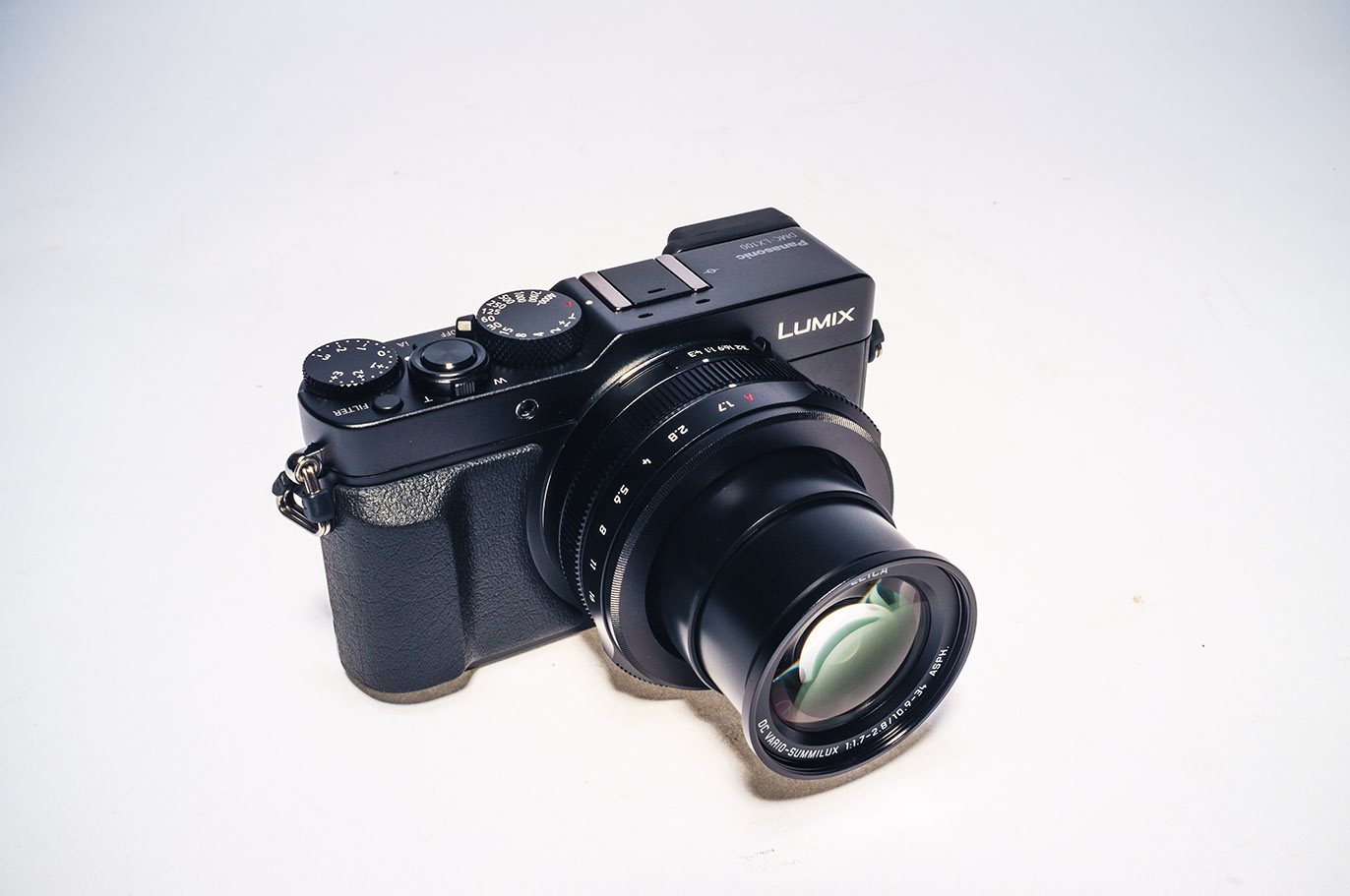
This is the camera that I would travel with...if I were travelling with a Panasonic camera. That's a personal value judgement and you're entitled to ask why - and then to make up your own mind. But here is my rationale for the Panasonic Lumix DMC- LX100:

1. The camera is all in one. No interchangeable lens to lose, no entry of dust or contaminants to the sensor. No cleaning. It is small and neat. It attracts little attention*

2. The lens is a Leica lens. Superb resolution and contrast. Aspherical elements so there is very little chromatic aberration - that is the killer defect of some other lenses for me and puts me off them. This one has no CA that I can see.


3. The lens has a true focal length range of 10.9 to 34 mm. This means that it has a chance of a very wide depth of field for landscape shots...and also for macro shots. The 35mm camera equivalent in the lens is 24mm to 75mm. That is classic landscape without distortion to classic portrait.

4. The lens will open up to to f:1.7 or f:2.8. That's low-light enough for most tourist shots w/out flash. It will stop down to f:16 and there's where the DOF becomes wonderful!

5. The sensor is 4/3" MOS - that's the same a Micro 4/3 size without the interchangeable lens to worry about. It cuts the world into 16.84 megapixels so there is plenty of resolution for A3+ prints....and I'd even test it out to A2...

6. It has an image stabiliser system - as it is small and light it needs something to keep it on track besides my shakey ol' hands.


7. Did I mention the close-up - goes down to 30cm at the tele end and 3cm at the wide end. I can take any details of cars or cannons that I want.

8. In case I want a flash there's a standard hot shoe and I can put a TTL flash on there.

9. 4K video recording for moving pictures. I have no idea what this is. I don't watch TV. I look at still pictures.

10. 4K video recording from which you can extract still pictures. Aha! Now I see where I could use this. I shoot a burst of frames of a Galapagos turtle streaking by and select the best one that is in focus. Interesting.

11. RAW/ JPEG and it's covered by my Adobe editing programs right now.


12. Eye-level viewfinder for the sunny days.

13. Direct control of aperture and shutter speed on traditional dials, with the option of a fast click off into aperture priority or shutter priority. This, camera makers, is the way it should be...always...


14. Quick external option for format change. This is a dangerous switch for the uninitiated as they may move it to a position that limits their results later on...and not realise they have done it. I shoot 3:2 mostly, but shift to 9:16 for big groups and 1:1 for some events where I don't want to be rotating the camera all night.

15. WiFi. I don't use it often, but when I am travelling I do like to fire some images back into the tablet for blogging. If I can do it without card shuffling and extra adapters, all the better.


So there. That's why I would travel with this Panasonic LX 100. As you see I travelled out to Jandakot to see what it did on the runway.

* I attract enough attention in other ways. That steam-powered destroyer siren was a darned good idea.

See the Panasonic LX 100 on the Camera Electronic website 


Labels: , , , , , ,

Wednesday, October 19, 2016

The Travel Trail - Part two - Micro 4/3 In The Hand


The first of our Panasonic Travel Trail cameras was small but capable - our next candidate gains a little in size, but introduces you to a whole system of photography - it is a photo trail you can follow for years...This one is the Panasonic Lumix DMC-GX85.

Panasonic Micro 4/3 system cameras have lenses that clip on and off - you can choose from a wide variety of different ones for specialised or general tasks. And you can use lenses from other micro 4/3 manufacturers - they have all come to agreement on that.

The other great advantage for this camera is the increased size and capability of the sensor 4/3 " Live MOS with 16.84 megapixels. Together with increased processor power this gives increased detail and resolution and you can blow your pictures up larger.

As with the smaller Panasonic camera, it has the 4K video recording and can also benefit from the post-focus selection system when you take a fast photo burst in 4K.


You'd like Wifi? It's in there. You'd like to control it remotely with your smartphone or tablet? There's an app for that. Want the convenience of a touch screen? Touch away - the GX85 screen responds instantly.


If you would like to work close to the ground with a macro lens - and Panasonic make some beautiful close-up lenses - you can flip the screen out flat like an old-fashioned waist-level finder and look down without getting down. I use a camera with this feature all the time at car shows to get a natural angle on the vehicles while standing. You are not inconvenienced and are much less conspicuous in a crowd.


The lens that you see on this camera is the Panasonic Lumix G Vario 14-140mm f:3.5-5.6 Aspherical lens with a powered image stabilising system.  It has nearly the same angles of view as the lens attached to the DMC-TZ110 but a greater heft - well, it needs this as the sensor is larger. It is also a perfect overseas travel lens and tourists with this attached never need to undo it throughout the trip - no letting dust and bugs into the camera.

Of course once you are home, the sky is the limit with Panasonic lenses -from fisheye to extreme telephone and some of the fixed prime lenses have a very advanced performance in low light.


Note that this camera has an extendable flash tube that pops up from the top housing of the camera when you press a button. Good for macro and for adding highlights to faces that are close to the camera. You can plug into speed lights or any sort of studio flash you fancy with the top hot shoe.

Okay - more space needed to carry this camera, and more weight to haul. This is balanced by later detailed pictures and the chance to use different lenses. The hand grip is also larger and easier to use. You choose which side of the compromise you feel best on.      

See the Panasonic Lumix DMC-GX85 on the Camera Electronic website here

Labels: , , , , , , , ,

Thursday, September 22, 2016

Get A Grip Week - Day Three - Fujifilm Boxes On


Retro is as retro does - and if that isn't as fatuous a statement as you are likely to read in a camera column...read on. It gets worse.

Fujifilm struck a real chord with the digital camera-buying public a few years ago when they brought out a retro camera. It's not rude to say that - the Fujifilm X-100 series of cameras have been deliberately styled to look and feel like cameras from the film era. Those of us who used film cameras can relate pretty nearly instantly to them as far as ergonomics go.

We get to touch a shutter speed dial, an aperture ring, and a focusing ring. We get a mechanical shutter button - They're even retro enough to take a mechanical cable release. We get an optical viewfinder, an electronic viewfinder, and an LCD live screen.

But we also get a pretty small and somewhat slippery camera body. I won't say that it is likely to squirt out of your fingers like a buttered squid, but you need to have your digits in the right place to operate it. If they are big sausage fingers you can be fighting for space. Enter the X-100 series grip:


It's a chunky monkey all right, with enough hand grip to allow to to pretty well let go of the camera with the left hand for good. The camera has got a fixed lens that is very compact. Even with an additional lens hood or filter holder, it is never going to overpower your right wrist like a long zoom would. If you are the sort of shooter who favours a wrist strap instead of a neck strap, this is the ideal way to secure the camera.

Note that it is cut out for card/battery replacement without being disturbed, and the bottom of the grip incorporates an Arca-Swiss rail fitting.

Now suppose you have decided to get the newest of the Fujifilm cameras - the X-T2. Can you be accommodated? You can:


Here the emphasis is on practicality rather than just accessorising for the sake of spending money in a camera shop (not that we discourage this...). The 18-135, 55-200, and 50-140 lenses are all substantial devices - they contain a great deal of heavy glass. They can twist a camera out of your right hand very easily, and it is awkward. This grip strengthens your chances. I also noted that the 1/4" screw was captive on a C-clip, though the battery door is accessible and the X-T2 has the card door on the side of the body anyway.

Please note that there are grips for the X-T1 and the X-E1 and 2 series as well.


Labels: , , , , ,

Wednesday, September 21, 2016

Kit Without Being Kitsch - the Fujifilm 18-55 lens


Sometimes you look out over the vast heaving sea of camera lenses and all you can see to the horizon is...kit lenses. Whether they are attached to Canon, Nikon, Olympus, Sony, or Fujifilm digital cameras*, they are there in serried ranks - ready to head out to take the initial shots.

People sometimes think of them as stop-gap measures...lenses that you use until you can purchase something bigger and longer and faster and more expensive...training-wheel lenses, if you will. Well, as a camera shop we would never discourage you from buying more lenses, but we can let you into a litle secret at the outset...kit lenses are very good.

It's percentages really - you can say that, for an average shooter, the camera set at factory defaults and on an automatic setting will deliver the picture they want about 85% of the time. It's the same for the kit lens - Average Joe or Average Jane will get what they need 85% of the time with the kit lens - particualrly if it is an 18-55mm focal range for an APS-C camera.

Of course as they advance in knowledge and skill, they become Excellent Joe and Excellent Jane and find they need wider, faster, longer, closer, etc in their lenses. And they can expect to pay more money and we can expect to take it. Isn't nature wonderful? But there is still a solid foundation of goodness in that kit lens.

The 18-55mm f:2.8-4 R LM OIS lens from Fujifilm can be clapped onto a new X-T2, X-Pro2, X-E2s, X-T10...or any of their older cousins...and for the most part stay clapped on there. It would be a very hard choice to beat for family pictures, casual portraits, landscape trips, holidays, car shots, pet shots, and product shots.

I could do a great wedding with one - I use flash for weddings - and the people who use the higher ISO settings on the newer cameras could do pretty much as well. The facility of not having to change lenses between shots would be priceless. For the techno-geeks out there who point out the inherently higher distortion percentages of any zoom lens vs any prime lens my answer would be: " When was the last time you saw a bride who was made up of right angles? ".

The OIS is the key to most of what this baby can do on the run. Lots of camera systems now have some form of stability aid - some are in the lenses and some in the bodies. This one goes with the Fujifilm idea of having it in the lens - whatever type, the effect is to allow you to use two shutter speeds slower than you could normally hold without paying a picture penalty. It won't take the place of a tripods for some work but it'll get you closer to that decision line than before.

As a trip lens it would be perfect if you were going to do urban and semi-rural pictures. I'd not hesitate to use it as the ONLY lens for a European or North American tour if I was not out in the bear-and-mountain-goat belt. Everything else would be well within the reward zone. Note: for wildlife you need longer lenses and for little life you need the Fujifilm 60mm macro lens. But you knew that already.

The one clincher for a kit lens is the price - they are often significantly less expensive than the exotic lenses in any manufacturer's range. Combine that with their utility and you've got a combo that you can't really beat! They're easy to pickup...( groan...)

*No, Virginia, you can't attach the same lens to all the cameras. At least not without a hammer and bad language...


Labels: , , , , , , , , , , ,

Tuesday, August 30, 2016

Do Not Unravel When You Travel - A Fujitale


You may not own a Fujifilm camera or five, and you may not have a Fujinon lens or five and a Fujifilm flash or two, but this column still has a message for you. And if you DO own the foregoing, you need to sit up and take notice right now.

Camera manufacturers sometimes engage bag making companies to make branded carry-alls, rucksacks, or promotional duffel bags. Most of them are just an excuse to get the brand name out there on show, and can be seen as a cynical exercise in geek training. The marketing department probably sit around in a karaoke bar on the Ginza at 3:00AM making bets on whether they can get their fan-boys to buy underwear with the camera name emblazoned on it...

But occasionally they do a good thing - Fujifilm has with this bag. It is referred to as a travel bag - as opposed to a fashion bag. It has enough useful features to lift it from the money-trap class and put it into the working line. Let's start out with the premise that it IS for a traveller....

The basic size is small enough when you see it not to excite the airlines into a frenzy. It will go into an overhead locker. It is amateur - looking enough to warn them that you will make a hideous shindy if they try to slug you for excess baggage. You can also overbear them if you look totally professional and bitter, but anything in between is inviting trouble.


Inside the first flap are dedicated pockets for memory cards, batteries, a mobile phone, pencils, and business cards.


Inside the second zippered flap is a multi-configurable compartment with velcro partitions. Nothing new about that until you look along the side of the bag...


And there is a zipper running underneath the whole thing. After you unhook and unzip this the bag widens dramatically and you can fit in several bodies, multiple lenses, a flash and triggering accessories. The really interesting thing is the cynicism shown by Fujifilm, who have no confidence in the abilities of either the owners or the baggage handlers. They have included padded cubes with velcro fasteners that can be put under bodies and lenses that are going to be subjected to extra love from the handlers. You just configure the thing as you need.


Of course there is a shoulder strap to take the weight, and of course the size of the open carry compartment will tempt Fujifilm owners to carry far more equipment than they will ever need. That is human nature. Since the case sits on padded rubber feet as well, you can set it down on wet asphalt when you run out of energy without doing the gear any injury.

Note there is a tablet space there inside as well.

You will not injure your wallet either - this whole shooting match goes for under $ 60. Come on down to Camera Electronic and fill it up with new lenses.

Labels: , , , , ,

--> Camera Electronic

Camera Electronic